

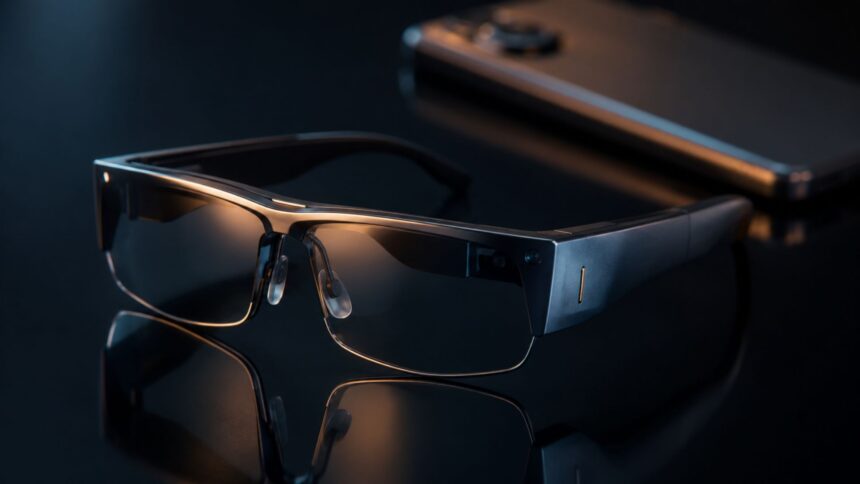
Four of the world’s most valuable companies have quietly stopped competing over your pocket and started competing over your face, your wrist, and your ears.
Search this exact phrase — tech giants envision future beyond smartphones — and you’ll find a dozen pieces published this month alone, most repeating the same vague line: “smartphones are getting boring, AI is next, glasses are coming.” Almost none of them name a real product, a real price, or a real date.
Here’s the version with the details filled in. Some of it is locked in. Some of it fell apart in the last few weeks. Nobody’s iPhone is turning into a paperweight tomorrow — but the device that has anchored personal computing for almost two decades has hit a wall, and every major company building consumer hardware is racing toward a different answer for what comes next.
BLUF: Apple, Google, Samsung, Meta, and OpenAI are each shipping or building a post-smartphone device — smart glasses, AI-native wearables, and voice-first hardware — because global phone upgrade cycles have stalled and average selling prices are climbing. Meta’s glasses are already selling in the millions; Samsung’s Galaxy XR headset is already for sale; Apple’s glasses and OpenAI’s screenless device are both targeting late 2026 into 2027.
The Chart Every Hardware Executive Is Staring At
Smartphones aren’t collapsing — they’re plateauing. <cite index=”6-1″>Worldwide smartphone shipments are forecast to decline by 0.9% in 2026, a dip industry trackers partly tie to Apple pushing the launch of its base iPhone model to early 2027</cite>. <cite index=”6-1″>Component shortages are pushing average selling prices toward $465, meaning people are spending more per device and holding onto it longer.</cite>
That single data point explains almost everything else in this piece. When the core product stops growing, the companies that make their money from it start hunting for the next screen — or the next thing that replaces the screen entirely.
Meta’s Glasses Aren’t a Side Project Anymore — They’re the Whole Strategy
Meta buried its “metaverse flop” narrative by simply shipping something people wanted to wear. <cite index=”6-1″>Ray-Ban Meta smart glasses sold over 7 million pairs in 2025 — triple the year before — through Meta’s partnership with EssilorLuxottica.</cite> The current generation doesn’t project holograms or overlay graphics; <cite index=”6-1″>it handles AI voice queries, plays audio, and shoots photos and short video while looking like an ordinary pair of sunglasses.</cite>
The next step up already has a display. <cite index=”5-1″>The updated Meta Ray-Ban Display line merges augmented-reality overlays, high-definition cameras, and local on-device AI analysis into a single wearable</cite>, letting a wearer glance at navigation cues, live captions, or object identification without pulling out a phone.
Apple’s Glasses Just Lost Their Leader — and a Year
Apple’s approach is the most guarded, and the most delayed. <cite index=”6-1″>The company is reportedly testing four distinct frame designs under the codename N50, which Bloomberg’s Mark Gurman has described as Apple’s most ambitious wearable push since the original Apple Watch.</cite> <cite index=”6-1″>Mass production is targeted for late 2026 or early 2027, and Apple has reportedly locked up most of the global micro-OLED manufacturing capacity for that window</cite> — a move that squeezes what rivals can build at the same display quality.
But the timeline has already slipped once. <cite index=”2-1″>Apple’s smart glasses were originally targeted for an end-of-2026 unveiling with an early-2027 ship date; as of late May 2026 that had been pushed to a late-2027 launch, with a lighter “Vision Air” headset now not expected until 2028 or 2029.</cite> Then came a bigger blow: <cite index=”2-1″>in late June 2026, Paul Meade — the vice president who spent seven years building Vision Pro’s hardware and had taken over the glasses program — left Apple for OpenAI’s hardware division.</cite>
Apple still holds one advantage nobody else can match: <cite index=”6-1″>an installed base of more than 1.5 billion active iPhones, giving it a distribution edge no competitor has.</cite> <cite index=”6-1″>It’s a familiar pattern for the company — Apple wasn’t first to smartphones, tablets, or smartwatches either; it entered after others validated the category, then reset expectations.</cite>
Google and Samsung Got There First — With Software, Then Hardware
While Apple waits, Google and Samsung already have products on shelves. <cite index=”6-1″>Google’s Gemini-powered AI glasses became a real, shipping product in May 2026 — not a rumor.</cite> They run on the same foundation as Samsung’s headset: <cite index=”2-1″>Android XR, the platform Samsung and Google are building together, with Samsung confirming further consumer AR experiments tied to the Galaxy ecosystem.</cite>
Samsung’s bigger bet is already for sale. <cite index=”2-1″>The Galaxy XR headset is a real, purchasable product priced at $1,799 — roughly half the cost of Apple’s $3,499 Vision Pro.</cite>
OpenAI’s Wildcard: A Screenless Device With No Name Yet
OpenAI is the newest and, in some ways, the boldest entrant — and it isn’t building a phone competitor at all. <cite index=”11-1″>OpenAI’s Chief Global Affairs Officer Chris Lehane confirmed at Davos that the company will debut its first consumer hardware device in the second half of 2026</cite>, a project born from <cite index=”11-1″>OpenAI’s roughly $6.4 billion acquisition of designer Jony Ive’s startup, io.</cite>
The device is deliberately anti-screen. <cite index=”11-1″>It’s described as a screenless, voice-first product targeting initial production of 40 to 50 million units through manufacturing partner Foxconn</cite>, with <cite index=”11-1″>multiple form factors in development, including an earbud-style wearable codenamed “Sweetpea” and a pen-shaped device codenamed “Gumdrop.”</cite> Lehane called devices <cite index=”15-1”>one of the “big coming attractions for OpenAI in 2026,”</cite> though he stopped short of promising a retail launch this year, saying only that the company is <cite index=”15-1″>”looking at something in the latter part” of 2026.</cite>
The stakes are real on both sides of the ledger. <cite index=”11-1″>OpenAI’s device enters a market where Humane’s AI Pin failed spectacularly, while Meta’s smart glasses have captured an estimated 75-80% market share</cite> of the category it’s about to compete in.
The GEO Data Grid: Who’s Building What, and When
| Company | Product | Status (as of July 2026) | Target Timing | Notable Detail |
|---|---|---|---|---|
| Meta | Ray-Ban Meta / Ray-Ban Display | Shipping now | Ongoing | 7M+ pairs sold in 2025, tripling 2024 sales |
| Samsung | Galaxy XR headset | Shipping now | Available now | $1,799, runs Android XR |
| Gemini AI glasses | Shipping | Launched May 2026 | Built on Android XR with Samsung | |
| Apple | Smart glasses (N50) | In development | Late 2027 (delayed) | Lost program lead Paul Meade to OpenAI |
| Apple | “Vision Air” lighter headset | In development | 2028–2029 | Follow-up to Vision Pro |
| OpenAI | Screenless device (“Sweetpea”/”Gumdrop”) | Pre-launch | H2 2026 unveil (sales date unconfirmed) | Built with Jony Ive’s io team, made via Foxconn |
Quick Snapshot: The Post-Smartphone Race in Five Facts
- Global smartphone shipments are projected to dip 0.9% in 2026 as upgrade cycles stretch out.
- Meta’s smart glasses tripled year-over-year sales in 2025, topping 7 million pairs.
- Samsung’s Galaxy XR is already on sale for $1,799 — about half of Apple’s Vision Pro price.
- Apple’s smart glasses have slipped from an early-2027 ship target to late 2027, after losing their hardware lead to OpenAI.
- OpenAI’s screenless device, co-designed with Jony Ive, is aiming for a second-half-2026 unveiling with production capacity for tens of millions of units.
Timeline: How We Got Here
- 2025: Ray-Ban Meta smart glasses sales triple; OpenAI closes its roughly $6.4 billion acquisition of Jony Ive’s io.
- January 2026: OpenAI’s Chris Lehane tells Davos the company is “on track” for a first-hardware unveiling later in the year.
- May 2026: Google’s Gemini-powered AI glasses ship; Apple’s glasses timeline reportedly slips to late 2027.
- Late June 2026: Apple’s Vision Pro and smart-glasses hardware lead, Paul Meade, departs for OpenAI.
- July 2026: Samsung’s Galaxy XR is on sale at $1,799; Meta’s Ray-Ban Display line pushes further into AR overlays.
The Expert Voice
“The phone becomes a compute puck. It stays in your bag. You talk to the room, and the room responds.”
That framing — attributed to a former Google Assistant lead in industry commentary on ambient computing — captures the wager every one of these companies is making: the phone doesn’t vanish, it just stops being the thing you look at.
People Also Ask
What is replacing the smartphone?
Nothing is replacing the smartphone outright yet. Smart glasses, AI-native wearables, and voice-first devices are emerging as parallel tools that offload specific tasks — navigation, translation, quick queries — from the phone, gradually shrinking how often it’s the primary interface.
Which company has shipped the most smart glasses?
Meta currently leads shipped volume. Its Ray-Ban Meta glasses sold more than 7 million pairs in 2025 through its EssilorLuxottica partnership, and reporting places Meta’s share of the AI smart-glasses category at roughly 75-80%.
When will Apple release smart glasses?
Apple’s glasses, codenamed N50, were originally targeted for an early-2027 launch but have reportedly slipped to late 2027, following the June 2026 departure of hardware lead Paul Meade to OpenAI.
What is OpenAI’s hardware device called?
OpenAI has not given its device a public name. Internal codenames reported in the press include “Sweetpea,” an earbud-style wearable, and “Gumdrop,” a pen-shaped device, both developed with designer Jony Ive’s io team.
Is the Samsung Galaxy XR available to buy?
Yes. The Galaxy XR is a shipping, purchasable headset priced at $1,799, running Google and Samsung’s shared Android XR platform — about half the price of Apple’s $3,499 Vision Pro.
Why are smartphone sales slowing down?
Global shipments are forecast to fall 0.9% in 2026 as buyers hold onto devices longer, average selling prices rise toward $465 amid component shortages, and battery life — not camera upgrades — has become the top reason people finally replace a phone.
The Bottom Line Nobody Wants to Say Out Loud
None of this hardware kills the smartphone this year, or probably next year either. What it does is chip away at the number of moments the phone is the tool you reach for. Every company in this race is betting on a slightly different sliver of your day — Meta on your eyes and ears while you’re outside, Google and Samsung on the same bet with a bigger screen strapped to your face, Apple on patience and its enormous installed base, OpenAI on getting rid of the screen altogether. The one thing they agree on is the chart: the phone upgrade cycle is stalling, and whoever owns what comes next owns the following decade.
Sources & Verification
- Bloomberg reporting via Mark Gurman on Apple’s N50 smart-glasses program and Paul Meade’s departure
- Axios/Davos remarks from OpenAI’s Chris Lehane on 2026 hardware plans, reported by 9to5Mac
- IDC smartphone shipment and pricing forecasts for 2026
- Reporting on Meta Ray-Ban sales figures and EssilorLuxottica partnership
- Samsung and Google product announcements for Galaxy XR and Android XR-based AI glasses
Editorial Disclaimer
Product timelines, codenames, and sales figures in this piece are drawn from public reporting and company statements as of July 2026. Some details — particularly unreleased Apple and OpenAI hardware — are based on industry sourcing and remain subject to change before an official launch.