

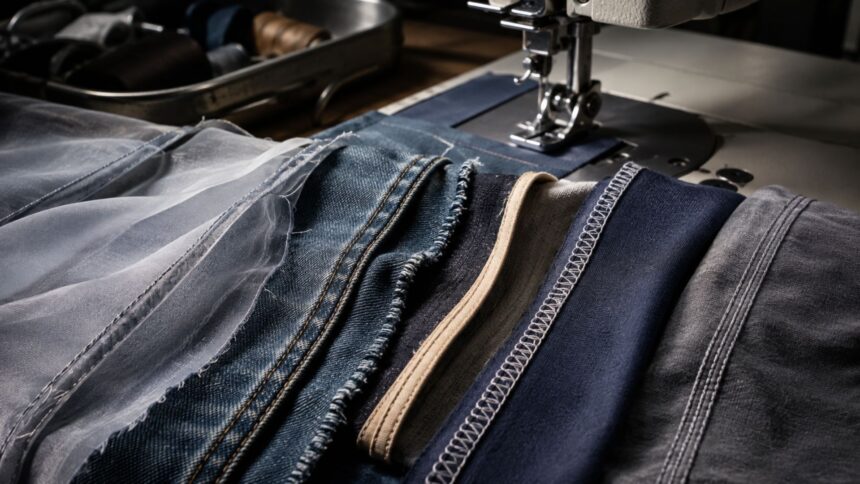
The difference between a clean, durable garment and one that puckers, frays or splits often begins with a decision hidden inside the fabric.
Search for Nahttypen, and you will often find two very different subjects mixed together: seam construction and stitch formation. They work as a system, but they are not interchangeable.
A French seam, flat-felled seam and bound seam describe how materials and raw edges are arranged. A lockstitch, chainstitch, overedge stitch and coverstitch describe how threads interlock or interloop to secure that arrangement.
That distinction matters. The wrong combination can produce broken stitches in stretch fabric, bulky ridges in underwear, fraying inside an unlined jacket or visible puckering across an otherwise well-made garment.
Nahttypen are the structural methods used to join, finish, reinforce or decorate textile components. The correct choice depends on fabric weight, stretch, load, bulk, appearance and available machinery. Seam construction and stitch formation are related, but they are not the same technical decision.
Nahttypen at a Glance
- Language: German
- Singular form: Nahttyp
- Direct English meaning: Seam type
- Primary field: Sewing, garment construction and textile manufacturing
- International classification: ISO 4916
- Related stitch standard: ISO 4915
- Common practical examples: Plain, French, flat-felled, lapped, bound, overlocked and flat seams
- Main selection factors: Material, stretch, loading, edge stability, comfort, bulk and appearance
ISO 4916 classifies and designates stitched-seam constructions, while industrial sewing references distinguish seam type from stitch type, material arrangement and the number of stitch lines used.
The First Technical Divide: A Seam Is Not a Stitch
A seam type describes the physical construction of the joint. It tells a technician how fabric components overlap, meet, fold, wrap or receive an additional binding.
A stitch type describes the thread-forming mechanism used to hold that construction together. Dürkopp Adler defines stitch type through the method of thread interlacing or interlooping and groups machine stitches into six broad classes.
A seam finish protects or conceals a raw edge. It may be produced during the joining operation, as with many overlock seams, or added after a plain seam has already been sewn.
| Technical term | What it describes | Example |
|---|---|---|
| Seam type | Arrangement of fabric components | Flat-felled seam |
| Stitch type | Formation of sewing threads | 301 lockstitch |
| Seam finish | Treatment of raw fabric edges | Overcasting or binding |
| Seam allowance | Material between the stitch line and cut edge | Allowance pressed open |
| Stitch line | Individual line of formed stitches | One or two rows of topstitching |
This explains why calling every serged edge an “overlock seam” can be misleading. A serger may only finish a single raw edge, or it may trim, join and finish several layers in one operation. The visible stitch does not, by itself, reveal the complete seam construction.
Four stitch numbers that remove much of the confusion
301 lockstitch is the familiar straight machine stitch formed with a needle thread and bobbin thread. It creates a tight, relatively low-bulk result, but its limited elongation can make it unsuitable for seams that must stretch substantially.
401 chainstitch offers greater elongation and higher production efficiency than the 301 lockstitch, although it is bulkier and can be more vulnerable to runback if the chain is not secured properly.
504 three-thread overedge can neaten raw edges and join multiple plies. It has useful extension and is widely associated with overlock construction.
406 coverseam uses two needle threads and a looper thread. It is commonly used for knitted-garment hems and for attaching elastic or lace.
The Eight-Class Map Behind Industrial Nahttypen
ISO-style classification does not simply list popular household names such as “French seam” or “jeans seam.” It groups constructions according to the number and arrangement of components.
Coats’ technical interpretation of ISO 4916 identifies eight seam classes. The first four cover familiar joining constructions, while the remaining classes include ornamental work, edge finishing and component attachment.
| Class | Seam family | Construction principle | Familiar application |
|---|---|---|---|
| 1 | Superimposed seams | Two or more components are placed over one another and stitched near an edge | Plain garment seam |
| 2 | Lapped seams | One component overlaps another before stitching | Flat-felled or lapped construction |
| 3 | Bound seams | A separate strip encloses an exposed edge | Bias-bound neckline |
| 4 | Flat seams | Fabric edges meet without a conventional overlapping allowance | Flatlock underwear seam |
| 5 | Decorative or ornamental stitching | Stitches create a surface effect on one or more components | Pintucks, braid or piping details |
| 6 | Edge finishing or neatening | A cut or folded edge is secured against fraying | Serging, overcasting or hemming |
| 7 | Attaching separate items | An additional component is sewn to an edge or surface | Elastic attached to underwear |
| 8 | Single-ply construction | One component is folded and stitched into a finished form | Belt loop construction |
The numerical system is valuable in factory specifications because informal names can vary between countries, sewing rooms and brands. A technical drawing showing fabric cross-sections, stitch positions and stitch numbers communicates more accurately than a label such as “clean seam.”
Editorial stance: The name of a seam is only the starting point. Reliable construction requires the fabric arrangement, stitch formation, thread, stitch density and seam position to be specified together.
Seven Nahttypen You Will Actually Encounter at the Machine
Plain or superimposed seam: the everyday construction
A plain seam usually begins with two fabric pieces placed with their intended outer faces together. A stitch line joins the layers, after which the allowances may be pressed open or toward one side.
It is fast, adaptable and appropriate for a large share of woven garments. Its weakness is not necessarily the joining line; it is the exposed allowance. Fabrics that fray require overcasting, serging, binding, lining or another finishing method.
Superimposed seams can be made with a 301 lockstitch, 401 chainstitch, overedge formation or a combination stitch, depending on the product and performance requirement.
Best suited to:
- Shirts and blouses
- Dresses and skirts
- Woven trousers
- Linings
- Home-furnishing projects
Avoid using it without adaptation when:
- The inside will remain highly visible
- The material unravels aggressively
- The seam must stretch with knitted fabric
- The project cannot tolerate exposed allowances
French seam: two passes that hide the cut edges
A French seam encloses both raw edges inside a narrow folded construction. The first stitch line is made with the fabric arranged opposite to a conventional plain seam. The allowance is trimmed, turned and stitched again so the cut edges become trapped inside.
Its clean interior makes it valuable for lightweight or transparent woven fabrics where overlocking could remain visible through the material. It is especially useful in unlined blouses, fine dresses, lingerie and delicate home textiles.
A French seam is less suitable for thick materials because the repeated folding creates bulk. Tight curves can also be difficult to turn smoothly.
Best suited to: chiffon, voile, organza, lightweight cotton and other fine woven fabrics.
Main trade-off: an elegant enclosed finish in exchange for additional trimming, folding and sewing accuracy.
Flat-felled seam: enclosed strength for hard-wearing garments
A flat-felled seam encloses the cut edges and secures the folded construction with visible stitching. It is strongly associated with jeans, workwear, shirts and garments that must withstand repeated loading and laundering.
Unlike a French seam, the felled construction is usually designed to lie firmly against the garment and often becomes part of its exterior appearance. A double row of stitching may be visible, although exact industrial configurations vary.
Educational sewing references identify the flat-felled or Kappnaht construction as a highly durable choice for denim and work clothing.
Advantages:
- Raw edges are enclosed
- The seam lies relatively flat
- Topstitching reinforces the construction
- The inside can remain clean without lining
Limitations:
- More preparation than a plain seam
- Difficult on extremely tight curves
- Can become rigid in thick multilayer areas
- Accuracy affects the visible topstitching
Lapped seam: overlap instead of conventional allowances
In a lapped seam, one component is positioned over another and stitched through the overlapping area. The edges may be left flat, turned under or otherwise prepared before joining.
This construction is useful when opening two pieces and pressing allowances apart would be impractical. It frequently appears in leather goods, non-fraying materials, decorative panels, footwear and structured textile products.
ISO Class 2 includes lapped constructions with one or more rows of stitching. Coats describes this family as involving two or more plies whose plain or folded edges overlap.
The lapped seam can reduce internal bulk, but stitch placement is visible and must be controlled carefully. It also requires sufficient overlap to prevent separation under load.
Bound seam: when the inside deserves a designed finish
A bound seam uses an additional strip to enclose an exposed edge. The binding may be cut on the bias for flexibility around curves or cut straight where stretch is unnecessary.
Bound constructions are common in unlined jackets, bags, necklines, quilts, corsetry and premium interiors where an overlocked edge would appear unfinished.
In ISO Class 3, the binding folds around the material edge and is secured with one or more rows of stitching. Industrial examples use lockstitch or chainstitch formations depending on the application.
The critical detail: both sides of the binding must be caught securely. A beautiful upper line does not compensate for missed binding on the underside.
Overlocked and safety seams: fast joining with protected edges
An overlock machine can trim fabric, form a seam and cover the cut edges during one operation. This efficiency makes overedge constructions central to knitted garments and mass production.
However, not every overedge stitch is designed to carry a joining load. Coats states that the two-thread 503 formation is intended for single-ply serging and is not suitable as a primary seaming operation because it can flatten when loaded laterally. The three-thread 504 formation can finish edges and join two or more plies.
A safety seam combines a joining row with an overedge row. Industrial examples place a chainstitch or lockstitch beside the edge-finishing formation, giving the seam a distinct load-bearing line and separate protection against fraying.
Best suited to:
- Jersey T-shirts
- Sweatshirts
- Casual knitwear
- Children’s clothing
- Production sewing
- Woven garments requiring simultaneous joining and neatening
Flatlock and coverseam: similar appearance, different assignments
A flat seam brings fabric edges together with little or no conventional overlapping allowance. The construction reduces bulk against the skin and can be useful in underwear, sportswear and close-fitting knitted garments.
Industrial flat seams may use complex covering stitches. Dürkopp Adler identifies stitch type 606 as a multi-thread formation used to join knitted components edge to edge in flatlock construction.
A coverseam is often confused with flatlock because both show multiple needle lines and looper coverage. In practice, coverseam formations such as stitch 406 are frequently used for hems or attaching elastic, rather than joining two raw edges in a true butt-seam arrangement.
That difference becomes obvious on a T-shirt:
- The side seam may be overlocked.
- The lower edge may be folded and coverstitched.
- A performance panel may be joined with a flat seam to reduce chafing.
Match the Seam to the Fabric, Not the Trend
There is no universally superior seam. The most appropriate Nahttyp is the construction that delivers the required strength, stretch, thickness, comfort, wash resistance and appearance for a specific material.
| Fabric or project | Practical seam choice | Why it fits | Watch for |
|---|---|---|---|
| Lightweight chiffon | Narrow French seam | Conceals raw edges without visible overlocking | Excessive bulk on curves |
| Cotton shirt | Plain or flat-felled seam | Efficient construction with a clean finish | Puckering along dense stitching |
| Denim jeans | Flat-felled or reinforced lapped seam | Enclosed edges and durable topstitching | Thick intersections |
| Jersey T-shirt | Stretch-compatible overedge seam | Joins and finishes while allowing extension | Differential feeding and waviness |
| T-shirt hem | Coverseam | Allows a professional knitted hem | Tunnelling between needle rows |
| Unlined jacket | Bound seam | Creates a controlled interior appearance | Missed underside of binding |
| Leather panel | Lapped seam | Avoids bulky turned allowances | Permanent needle holes |
| Underwear or activewear | Flat or covered seam | Reduces bulk and skin irritation | Thread softness and recovery |
| Woven trousers | Plain seam with secure edge finish | Easy fitting and alteration | Seam slippage in loose weaves |
| Decorative panel | Lapped or ornamental construction | Makes stitching part of the design | Uneven spacing and distortion |
A fabric’s category alone is not enough. Two jerseys may have different stretch and recovery. Two denims may differ greatly in weight, weave density and elastane content. Testing the exact seam assembly on the actual production material is more reliable than relying on a universal setting.
Why Good Nahttypen Still Fail
ASTM D1683 identifies four linked seam-engineering variables: sewing-thread size, seam type, stitch type and stitch density. Their interaction affects sewn-seam strength, seam efficiency, slippage and structural integrity.
That means a strong-looking seam can still fail because the thread is too coarse, the stitch perforates the fabric excessively, the material slips away from the stitch line or the construction cannot extend with the garment.
Seam rupture
Rupture occurs when the sewing thread, fabric or both break under load. Adding more rows of stitching may increase security in some constructions, but excessive needle penetration can weaken sensitive materials.
A seam should not automatically be engineered to overpower the fabric. In repairable products, controlled thread failure may be preferable to permanent tearing or yarn displacement in the material.
Seam slippage
Seam slippage occurs when yarns shift away from the stitch line rather than the thread snapping cleanly. It is particularly relevant to loosely constructed woven fabrics.
ASTM’s test method measures seam behaviour under force applied perpendicular to the seam and distinguishes stitching failure from displacement of fabric yarns. It also states that laboratory testing does not directly predict every condition of real wear.
Puckering
Puckering appears as unwanted gathering, rippling or distortion along a seam. It may be caused by excessive thread tension, feeding differences, unsuitable needle or thread size, fabric structure or the seam construction itself.
Coats notes that puckering usually has more than one contributing cause. In tension puckering, an overstretched sewing thread relaxes after sewing and gathers the seam as it attempts to return to its previous length.
Reducing upper tension may help, but tension should not be treated as the only suspect.
Broken stitches on stretch fabric
A straight lockstitch can appear perfect while the garment is relaxed and then break when the fabric is pulled over the body.
The solution is not merely “use polyester thread.” The seam must have adequate extension through stitch formation, stitch geometry, thread behaviour and sufficient thread in each unit of seam length.
Runback and unraveling
Some chain-based formations can unravel progressively if their ends are not secured. The 401 chainstitch offers greater elongation than a 301 lockstitch, but its chain formation must be protected against runback.
Factories address this through back-tacking, thread chaining, overlapping, bar-tacking or construction-specific securing methods.
Edge fraying
A joining line may remain intact while the allowance disintegrates beside it. Dürkopp Adler’s sewing reference notes that open textile edges often require overedge finishing, binding or another treatment to resist fraying.
This is why seam strength and edge security must be evaluated separately.
A Five-Question Test Before Choosing Any Seam
Before sewing the production garment, sample or technical prototype, answer five questions.
1. Will the material fray?
A stable felt, leather or laminated sheet behaves differently from linen, chiffon or loosely woven suiting. Materials with unstable cut edges usually require enclosure, overcasting or binding.
2. Must the seam stretch?
The seam needs enough extension to survive dressing, movement and recovery. Test it in the same direction and to approximately the same strain it will experience in use.
3. Will the seam touch the skin?
Bulky allowances and coarse looper threads may be acceptable inside a bag but uncomfortable in underwear, cycling clothing or compression garments.
4. Is the inside visible?
Unlined jackets, reversible garments, transparent fabrics and open bags often need a deliberately finished interior. A bound, French or enclosed seam may justify the additional operations.
5. What is the realistic failure mode?
Consider whether the product is likely to experience steady tension, repeated movement, abrasion, laundering, sudden loading or seam slippage. The seam should be tested against the actual risk rather than selected only for appearance.
Frequently Asked Questions About Nahttypen
What does Nahttypen mean in English?
Nahttypen means “seam types” in English. The term refers to different structural methods for joining, finishing, reinforcing or decorating fabric and other sewable materials. In technical garment production, a Nahttyp is identified separately from the stitch type used to create it.
What is the difference between Nahttyp and Stichart?
A Nahttyp is the seam construction, while a Stichart is the stitch formation. A flat-felled seam is a Nahttyp because it describes folded and enclosed fabric layers. A lockstitch or chainstitch is a Stichart because it describes how the sewing threads connect.
Which Nahttyp is the strongest?
The strongest Nahttyp is the construction best matched to its material and loading conditions. Flat-felled and reinforced lapped seams are associated with durable garments, but strength also depends on thread size, stitch formation, stitch density, fabric structure and sewing quality. No seam name guarantees maximum performance by itself.
Which seam type is best for stretch fabric?
A stretch-compatible overedge, safety, flat or covered seam is usually suitable for stretch fabric. The correct choice depends on how far the fabric must extend and where the seam is positioned. A narrow zigzag can also provide extension when only a domestic sewing machine is available.
Is a French seam stronger than a flat-felled seam?
A French seam is primarily a clean enclosed construction for fine woven fabrics, while a flat-felled seam is designed for flatter, more reinforced assembly. The flat-felled seam is normally better suited to denim and workwear. The French seam is usually preferable when delicacy and a concealed interior are more important than heavy-duty loading.
Can a domestic sewing machine produce professional Nahttypen?
A domestic sewing machine can produce many professional seam types, including plain, French, lapped, bound and flat-felled seams. Overlock, safety and industrial flat-seam constructions may require dedicated machinery. Careful pressing, trimming, edge control and consistent seam allowances remain as important as the machine itself.
The Seam Is the Engineering Decision You Cannot Hide
Nahttypen may sit inside garments, beneath bindings or under rows of topstitching, but their consequences remain visible.
A correctly chosen seam moves with the fabric, protects its edges, distributes loading and supports the intended silhouette. A poorly chosen one announces itself through ripples, broken threads, bulky ridges and distorted panels.
The practical rule is simple: choose the seam construction first, match the stitch formation to its job, and test the complete assembly on the real material. The most polished stitch line cannot rescue a seam whose structure was wrong from the beginning.
Sources & Verification
- ISO 4916:1991 — Textiles: Seam types, classification and terminology. Official ISO listing describing the classification, illustration and designation of stitched seams.
- Dürkopp Adler Nähtechnik-Lexikon — Nähnaht according to DIN ISO 4916. Industrial definition of a sewn seam and the criteria used to describe it.
- Dürkopp Adler Nähtechnik-Lexikon — Nähstichtyp. Technical explanation of stitch formation and industrial stitch classes.
- Coats Sewing Solutions — Seam Types. Technical bulletin describing the eight seam classes, applications and numerical designations.
- Coats Sewing Solutions — Basic Stitch Types. Technical details for lockstitch, chainstitch, overedge and coverseam formations.
- ASTM D1683/D1683M-22. Standard test method covering sewn-seam strength, seam efficiency, slippage and seam-engineering variables in woven fabrics.
- Coats Sewing Solutions — Eliminating Seam Puckering. Diagnostic guidance on tension puckering, material structure, feeding and other causes of seam distortion.
Editorial Disclaimer: This article provides general educational information about textile seam construction. Exact seam classifications, machine settings, terminology and performance requirements can differ by standard, manufacturer, material and product specification. Critical or regulated products should be engineered and tested by qualified textile professionals.