

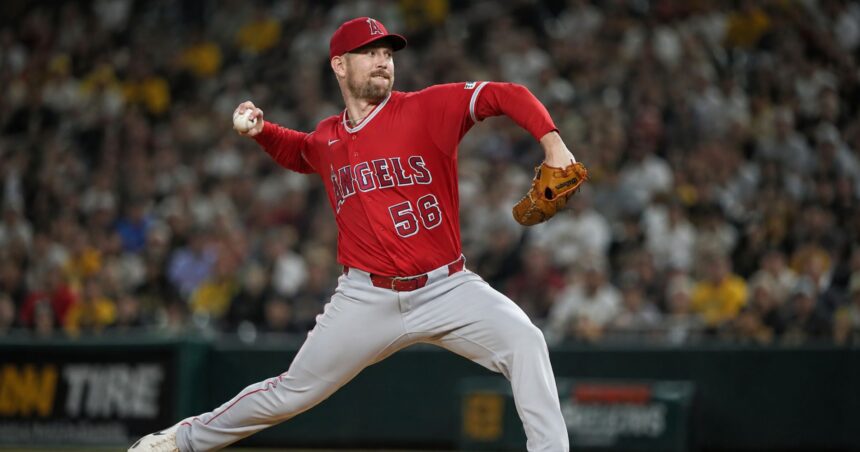
Ryan Zeferjahn to the Cubs: Why Chicago Traded Two Prospects for a 97-MPH Bullpen Weapon
The reported deadline deal gives Chicago a high-strikeout reliever with late-inning potential—but also places a major bet on his ability to command the strike zone.
Search interest in Ryan Zeferjahn surged on August 3, 2026, after multiple outlets reported that the Chicago Cubs had agreed to acquire the right-handed reliever from the Los Angeles Angels. The names appearing beside Zeferjahn in trend data—Moisés Ballesteros and Mason McGwire—were not incidental. They were the reported return heading to Los Angeles.
The deal became one of the day’s more intriguing trades because Zeferjahn is not an established superstar or an expiring-contract rental. He is a 28-year-old power reliever whose 2026 numbers—75 strikeouts, a 3.66 ERA and a 1.20 WHIP in 51⅔ innings—suggest that his best major-league work may still be ahead of him.
Chicago is buying velocity, swing-and-miss capability and future flexibility. Los Angeles is accepting the volatility attached to relief pitching and converting Zeferjahn into two younger players, including one of the more recognizable catching prospects in baseball. Because initial coverage described the transaction as a reported agreement, official team roster channels remain the final authority on its completion.
Ryan Zeferjahn is a 28-year-old right-handed reliever reportedly acquired by the Chicago Cubs from the Los Angeles Angels for Moisés Ballesteros and Mason McGwire. He brings a 97-mph fastball, a sweeping breaking ball, a 3.66 ERA and elite strikeout volume, but his walk rate remains the defining risk.
The Trade That Turned Ryan Zeferjahn Into a Deadline Headliner
The reported transaction sends Zeferjahn from the Angels to the Cubs while moving catcher/designated hitter Moisés Ballesteros and minor-league right-hander Mason McGwire to Los Angeles.
| Chicago Cubs receive | Los Angeles Angels receive |
|---|---|
| RHP Ryan Zeferjahn | C/DH Moisés Ballesteros |
| Immediate high-leverage bullpen candidate | RHP Mason McGwire |
| Power arm with pre-arbitration status | Two players aged 22 at the time of the trade |
Ballesteros entered the season as a prominent prospect and appeared in 59 major-league games, producing a .231/.303/.385 slash line with six home runs and 23 RBIs before returning to Triple-A. McGwire, the son of former MLB slugger Mark McGwire, recorded a 3.64 ERA and 72 strikeouts across 59⅓ minor-league innings in 2026.
That is a meaningful return for a reliever with fewer than three full MLB seasons. It indicates that Chicago valued more than Zeferjahn’s current ERA. The organization appears to be betting on his underlying pitch quality, durability, strikeout rate and remaining years before free agency.
Ryan Zeferjahn quick profile
- Full name: Ryan Joseph Zeferjahn
- Date of birth: February 28, 1998
- Age: 28
- Birthplace: Topeka, Kansas
- Height and weight: 6 feet 5 inches, 209 pounds
- Position: Right-handed pitcher
- Bats/throws: Right/right
- High school: Seaman High School in Topeka
- College: University of Kansas
- MLB Draft: Boston Red Sox, third round, 107th overall, 2019
- MLB debut: August 25, 2024, with the Los Angeles Angels
- Reported new organization: Chicago Cubs
A 97.4-MPH Fastball and the Sweeper That Changes the At-Bat
Zeferjahn’s appeal begins with a four-seam fastball averaging 97.4 mph and reaching 100.2 mph in 2026. That velocity forces hitters to prepare for the top of the strike zone, creating a sharp visual and movement contrast with his mid-80s sweeper.
His sweeper averages 85.3 mph, moves approximately 14 inches away from a right-handed hitter and remains his most recognizable secondary weapon. He also uses a sinker, a harder slider and an occasional curveball, giving him more options than a conventional two-pitch reliever.
| Pitch | Average velocity | Maximum velocity | Strike-zone rate | Likely purpose |
|---|---|---|---|---|
| Four-seam fastball | 97.4 mph | 100.2 mph | 40% | Elevated velocity and strikeouts |
| Sinker | 96.1 mph | 98.9 mph | 48% | Arm-side movement and early contact |
| Slider | 88.6 mph | 92.8 mph | 50% | Harder breaking option |
| Sweeper | 85.3 mph | 89.7 mph | 46% | Chase pitch with horizontal movement |
| Curveball | 84.3 mph | 89.3 mph | 18% | Occasional speed and shape disruption |
The pitch data comes from MLB’s 2026 Statcast visualization report.
The attraction is obvious: batters must cover upper-90s velocity and a breaking ball moving in a dramatically different direction. When Zeferjahn locates both pitches, clean contact becomes difficult.
The concern is equally clear. He issued 32 walks while facing 224 batters for the Angels in 2026. His four-seamer entered the strike zone on only 40% of pitches, while the curveball landed in the zone just 18% of the time. Hitters who refuse to chase can force him into long plate appearances or reach without putting the ball in play.
Editorial assessment: Chicago is not acquiring a finished, low-risk closer. It is acquiring closer-level raw material. The deal succeeds if the Cubs preserve Zeferjahn’s unpredictability while reducing the free passes that prevent him from consistently controlling the ninth inning.
The performance trend Chicago is buying
| Season | Games | ERA | Innings | Strikeouts | WHIP | Saves |
|---|---|---|---|---|---|---|
| 2024 | 12 | 2.12 | 17.0 | 18 | 0.76 | 0 |
| 2025 | 62 | 4.74 | 57.0 | 73 | 1.47 | 2 |
| 2026 | 45 | 3.66 | 51.2 | 75 | 1.20 | 4 |
| MLB career | 119 | 3.94 | 125.2 | 166 | 1.27 | 6 |
The 2026 strikeout increase is particularly notable. Zeferjahn surpassed his entire 2025 strikeout total despite throwing more than five fewer innings. His results also improved in ERA, WHIP and home-run prevention compared with his first full major-league season.
The Topeka-to-Majors Route Was Longer Than His Velocity Suggested
Zeferjahn grew up in Topeka and attended Seaman High School, where he earned All-City First Team, All-Centennial League First Team and Topeka Pitcher of the Year recognition. His size and arm strength made him an important Kansas prospect before he enrolled at the University of Kansas.
At Kansas, he developed into one of the program’s most accomplished strikeout pitchers. He recorded 100 strikeouts in 2018 and 107 in 2019, becoming the first Jayhawks pitcher to produce consecutive 100-strikeout seasons. He also became the first player in program history selected to a Baseball America College Baseball Preseason All-America team.
His university résumé included 2018 All-Big 12 Second Team honors, Academic All-Big 12 recognition and a 14-strikeout performance against Texas Southern. Kansas listed him as a business major, although the available university and MLB biographies do not confirm whether he completed the degree.
Boston selected Zeferjahn with the 107th overall pick in the 2019 draft. His progression through the Red Sox system was uneven. He began as a starter, but his combination of velocity and inconsistent command eventually made relief work the more practical route.
By 2024, the transition was producing results. Zeferjahn opened that season with seven scoreless appearances at Double-A Portland, reached Triple-A Worcester and was included in Boston’s July trade for veteran reliever Luis García. The Angels received Zeferjahn, Matthew Lugo, Niko Kavadas and Yeferson Vargas in that transaction.
Los Angeles promoted Zeferjahn to the majors in August. He responded with a 2.12 ERA, 18 strikeouts and only seven hits allowed across his first 17 MLB innings. That brief debut established that his arsenal could retire major-league hitters, even if a larger sample was needed to determine his eventual role.
Ryan Zeferjahn’s defining timeline
- 2016: Completes a decorated pitching career at Seaman High School in Topeka.
- 2017: Begins his college career with the Kansas Jayhawks.
- 2018: Records 100 strikeouts and earns All-Big 12 Second Team recognition.
- 2019: Reaches 107 strikeouts and is drafted 107th overall by Boston.
- 2022: Works primarily in relief as the Red Sox begin reshaping his development path.
- July 2024: Traded from Boston to the Angels in the Luis García deal.
- August 2024: Makes his MLB debut for Los Angeles.
- 2025: Completes his first full major-league season, appearing in 62 games.
- 2026: Improves to a 3.66 ERA with 75 strikeouts and four saves before the reported Cubs trade.
An Athletic Family Thread Runs Through the Zeferjahn Story
Ryan Zeferjahn is the son of Darin and LaTisha Zeferjahn. He has a sister, Lauren, and a brother, Nathan. His mother played both basketball and softball at Washburn University, giving the family a documented connection to college athletics before Ryan reached Kansas.
Two maternal uncles also competed at notable levels. Lucas Yarnell played football at Louisiana-Lafayette and later joined the Kansas City Brigade in arena football. Lyndall Yarnell played defensive end for Kansas during the 1980s.
The available record therefore supports a sports-connected family environment. It does not provide verified information about his parents’ professions, the family’s deeper ancestry or ethnic origins. Those details should not be invented from the surname or from unsourced biography websites.
Is Ryan Zeferjahn married?
Official MLB and University of Kansas biographies do not identify a spouse, children or confirmed relationship history. That omission should not be interpreted as proof that he is single. It means only that authoritative sports sources consulted for this profile do not document his current marital or parental status.
Zeferjahn has maintained a relatively low public profile compared with many professional athletes. Most established reporting about him concerns pitching development, transactions and game performance rather than his home life.
Why Chicago Was Willing to Pay a Prospect Premium
The Cubs entered the 2026 trade period needing pitching depth after spending significant portions of the season managing injuries across their staff. MLB’s reporting had already identified pitching help as a central Chicago deadline priority, with relievers Daniel Palencia, Hoby Milner and Hunter Harvey among the arms who had spent time on the injured list.
Zeferjahn offers immediate innings without limiting Chicago to a pure rental strategy. His 2026 contract status was listed as pre-arbitration eligible, and his major-league debut did not occur until August 2024. That service-time position suggests the Cubs are acquiring a pitcher they could retain beyond the current pennant race, although official service calculations and future labor rules will determine the exact control period.
That longer horizon helps explain the inclusion of Ballesteros. Chicago is not simply surrendering a notable young hitter for several weeks of bullpen coverage. It is attempting to exchange a player with defensive-position uncertainty for a power pitcher who could occupy a late-inning role for multiple seasons.
The evaluation can be reduced to three questions:
- Can Zeferjahn throw enough strikes to earn consistent high-leverage assignments?
- Can Chicago maintain his improved strikeout rate without making the arsenal more predictable?
- Will Ballesteros become the impact major-league hitter Los Angeles believes it is acquiring?
Reliever performance is notoriously volatile, so the trade cannot be judged only by Zeferjahn’s first month in Chicago. A better evaluation window will include his postseason usage, 2027 role and the development of both players sent to the Angels.
Ryan Zeferjahn Net Worth, Salary and Career Earnings
Ryan Zeferjahn’s net worth has not been publicly verified by an authoritative financial source. Although some biography websites may publish estimated figures, those numbers are not supported by financial disclosures, verified endorsement contracts or documented asset records.
The most reliable financial context comes from salary and career-earnings databases. Spotrac’s Ryan Zeferjahn contract page lists approximately $1.42 million in estimated MLB career earnings through 2026 and identifies him as a pre-arbitration player. Spotrac also lists a $780,000 salary for the 2026 season.
That salary aligns with the $780,000 MLB minimum salary for 2026 established under the league’s collective bargaining agreement. However, salary and net worth are not interchangeable. Taxes, agent commissions, training expenses, housing, investments, debts and private business arrangements can significantly affect a player’s actual wealth.
| Financial category | Verified or reported information |
|---|---|
| Estimated net worth | Not publicly verified |
| Listed 2026 salary | $780,000 |
| Estimated career earnings through 2026 | Approximately $1.42 million |
| Contract status entering 2026 | Pre-arbitration eligible |
| Primary known income source | Professional baseball salary |
| Endorsement earnings | Not publicly disclosed |
| Real estate and other assets | Not publicly disclosed |
Zeferjahn’s future earnings could rise considerably if he develops into a dependable closer or high-leverage setup reliever. Baseball-Reference lists him as arbitration-eligible in 2028 and eligible for free agency after the 2030 season, subject to official service-time calculations and future roster activity.
What is Ryan Zeferjahn’s net worth?
Ryan Zeferjahn’s net worth is not publicly known or independently verified. Spotrac lists roughly $1.42 million in estimated career earnings through 2026, but gross career earnings cannot establish personal net worth. A credible calculation would require access to his taxes, expenses, investments, debts, endorsements and privately held assets.
Verified Outbound Sources
Reuters trade report — Independent reporting on the Cubs-Angels transaction and the players involved.
MLB.com: Cubs trade report involving Ryan Zeferjahn — MLB’s coverage of the reported deal involving Zeferjahn, Moisés Ballesteros and Mason McGwire.
Official MLB player profile — Verified biographical details, transactions, measurements and playing history.
MLB Baseball Savant — Statcast pitching data, velocity, movement profiles and performance metrics.
University of Kansas Athletics profile — College achievements, education and documented family information.
Baseball-Reference player page — Service time, contract status and career statistics.
Spotrac contract and earnings profile — Reported salary, transaction and estimated career-earnings information.
Ryan Zeferjahn Questions Baseball Fans Are Asking
Who is Ryan Zeferjahn?
Ryan Zeferjahn is an American right-handed MLB pitcher from Topeka, Kansas. He attended Seaman High School and the University of Kansas before Boston drafted him in the third round in 2019. He debuted with the Angels in 2024 and was reportedly traded to the Cubs in August 2026.
What did the Cubs trade for Ryan Zeferjahn?
The Cubs reportedly sent catcher/designated hitter Moisés Ballesteros and minor-league pitcher Mason McGwire to the Angels for Zeferjahn. The return was significant because Ballesteros had reached the majors and remained a highly regarded young hitter, while McGwire had appeared in the 2026 Futures Game.
How fast does Ryan Zeferjahn throw?
Ryan Zeferjahn’s four-seam fastball averaged 97.4 mph and reached 100.2 mph during the measured portion of the 2026 season. He also threw a sinker averaging 96.1 mph and paired those fastballs with a sweeper, slider and curveball.
What is Ryan Zeferjahn’s best pitch?
Ryan Zeferjahn’s sweeper is his defining secondary pitch. It averages approximately 85.3 mph and moves sharply away from right-handed hitters. Its effectiveness increases because hitters must also react to a four-seam fastball arriving roughly 12 mph faster.
What are Ryan Zeferjahn’s 2026 statistics?
Before the reported Cubs trade, Zeferjahn was 4-3 with a 3.66 ERA, four saves, 75 strikeouts and a 1.20 WHIP in 45 appearances covering 51⅔ innings. He allowed 30 hits and issued 32 total walks.
What is Ryan Zeferjahn’s net worth?
Ryan Zeferjahn’s net worth is not publicly verified. The 2026 MLB minimum salary is $780,000, but a league minimum cannot be used as a substitute for personal wealth. No authoritative source reviewed for this profile publishes his assets, liabilities, investments or confirmed endorsement earnings.
The Trade Will Be Remembered for What Happens After the Headlines
Ryan Zeferjahn arrives at this career turning point with attributes every contender wants: size, upper-90s velocity, a bat-missing breaking ball and evidence that his strikeout ability is improving.
He also arrives with the problem that separates dominant closers from frustrating power arms. Too many plate appearances are still shaped by whether hitters chase pitches outside the strike zone.
Chicago’s bet is that this can be refined rather than rebuilt. Los Angeles’ bet is that a volatile reliever is worth converting into two younger assets before his value changes. The winner will not be determined by which side attracted the loudest deadline reaction. It will be determined by whether Zeferjahn commands October innings—and whether Ballesteros becomes the hitter the Angels believe they acquired.
Editorial Disclaimer: Trade details and statistics were checked against sources available at publication time. Breaking transactions can change pending medical reviews, official announcements or roster processing. Net-worth figures, private relationships and undisclosed contract terms are not presented as facts without authoritative confirmation.