
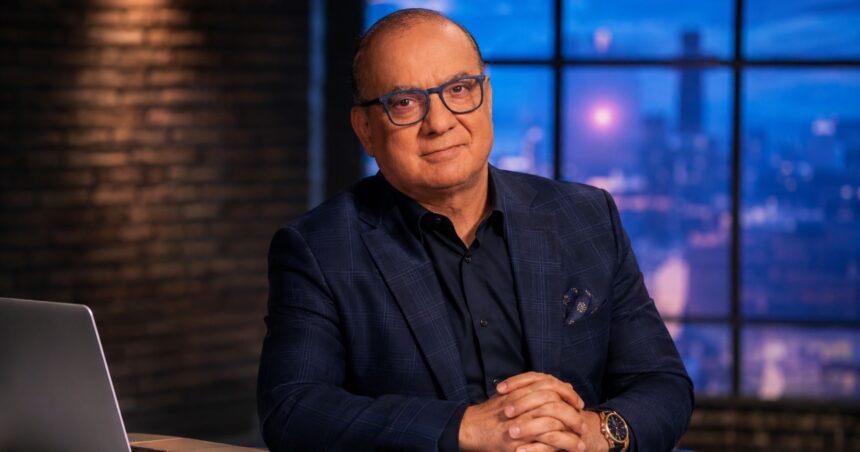
The sharply dressed investor became a television fixture, but his most consequential deals were made decades before he entered the Den.
Touker Suleyman’s exit from Dragons’ Den closes one of the programme’s longest-running chapters. In June 2026, the 72-year-old businessman confirmed that his forthcoming appearances would be his last, arguing that the show needed “new blood” after more than a decade in the famous investor’s chair. His final recorded episodes were scheduled to air later in 2026.
Yet television represents only one layer of Suleyman’s career. His wealth and commercial reputation were built through clothing manufacturing, property and the rehabilitation of distressed British fashion businesses—most famously Hawes & Curtis, acquired for a nominal £1 while burdened by debt.
Nor does leaving the programme appear to mean retirement. Weeks after announcing his departure, Suleyman backed David Gandy Wellwear in a strategic partnership intended to expand the menswear brand’s products, distribution and international reach.
Touker Suleyman is a British-Turkish Cypriot fashion entrepreneur, investor and departing Dragons’ Den panellist. He built Low Profile Holdings, revived Hawes & Curtis after acquiring it for £1, rescued Ghost, and announced in June 2026 that his final Den episodes would air later that year.
Touker Suleyman at a Glance
- Full name: Türker “Touker” Süleyman
- Date of birth: 4 August 1953
- Age: 72 as of 2 August 2026; he turns 73 on 4 August 2026
- Birthplace: Famagusta, Cyprus
- Heritage: Turkish Cypriot
- Nationality: British
- Known for: Low Profile Holdings, Hawes & Curtis, Ghost and Dragons’ Den
- Children: Two daughters, Tashia and Taya
- Education: Peckham Manor secondary school; no publicly verified university degree
- Reported wealth: Frequently estimated between £150 million and £200 million, although no current audited personal figure is publicly available
- Dragons’ Den tenure: Joined in 2015 and announced his departure in June 2026, with final episodes due later that year
From Famagusta to Bermondsey: The Family Enterprise Behind His Ambition
Suleyman was born in Famagusta on 4 August 1953. His accounts place his childhood migration to Britain in the late 1950s: one interview dates the move to 1958, while another describes his family arriving from northern Cyprus in 1959. They settled in Bermondsey, south London.
He arrived unable to speak English. The family did not enter Britain empty-handed, however. Suleyman has said that they brought capital with them, entered a restaurant partnership and later bought out their business partners. The restaurant trade gave him an early view of ownership, staffing, purchasing and cash flow rather than salaried professional life.
What is known about Touker Suleyman’s parents and siblings?
Public interviews do not reliably identify Suleyman’s mother or father by name, nor do they separate their individual duties within the restaurant operation. The defensible description is that his family ran a hospitality business after settling in London.
Suleyman has said that the family arrived with four children, indicating that he grew up with siblings. A separate business profile reports that he acquired the operation that became Low Profile with his brother in 1984. Names, birth order and detailed accounts of the other siblings have not been authoritatively published.
His father appears to have strongly favoured professional security. After school, family pressure helped steer Suleyman toward an accountancy firm, even though the younger man had already decided that he ultimately wanted to work for himself.
Eight O Levels, a threatened amputation and an unexpected business education
At Peckham Manor secondary school, Suleyman obtained eight O Levels despite beginning his British education without English. No verified record shows that he later attended university or completed a conventional degree.
At the age of 10, a serious infection in his left hand placed him at risk of amputation. He spent an extended period in hospital, lost a year of education and later recalled that three fingers stopped growing normally. He has connected that frightening period with his determination to control his own future.
After school, he joined an accountancy firm as a trainee for £5.50 a week plus expenses. The work gave him access to the financial records of small businesses—an education in margins, weak controls and commercial behaviour that later became central to his investment style.
The £20 Million Shock That Changed How Suleyman Assessed Risk
Suleyman’s entry into fashion was unusually direct. He bought clothing and used older women, including grandmothers, to sell garments through their personal networks. When the stock repeatedly sold out, he ordered more.
That experiment led to a leather factory and then Kingsland Models, a womenswear manufacturer that supplied established high-street retailers. Suleyman moved rapidly from small-scale selling into factories, wholesale production and public-company ambitions.
His confidence peaked after he took a 29.9% stake in clothing company Mellins. The share price reportedly rose from 3p to 360p, placing him on the boards of public companies while still in his twenties.
Then came the transaction that nearly destroyed him.
Mellins became involved with Bamber Stores, a retailer presented as a complementary acquisition: one company would manufacture the clothing, while the other would sell it. Suleyman grew suspicious and commissioned Coopers & Lybrand to review the accounts.
According to his account, the review found that a business believed to be profitable was approximately £20 million in deficit. Bamber collapsed, Mellins ran short of cash and a proposed £2 million rescue investment failed to materialise. Suleyman sold his house and started again.
The collapse formed the commercial logic viewers later saw on Dragons’ Den. Suleyman’s questions about cash, debt, margins, manufacturing costs and founder credibility were not theoretical. They came from discovering how quickly apparent success can disappear when financial information is unreliable.
The rebuilding years in chronological order
- 1953: Born in Famagusta, Cyprus.
- Late 1950s: Migrated with his Turkish Cypriot family to Bermondsey in south London.
- 1960s: Attended Peckham Manor and survived a severe hand infection that cost him a year of schooling.
- 1970s: Worked as an accountancy trainee before entering clothing sales and manufacturing.
- Early 1980s: Became involved with Mellins and Bamber Stores; the resulting collapse forced him to sell his home.
- 1984: Acquired a small cash-and-carry operation with his brother and developed it into Low Profile.
- 2001–2002: Took control of Hawes & Curtis for a nominal £1 while accepting its financial liabilities.
- 2008: Rescued women’s fashion label Ghost during the financial crisis.
- 2015: Joined the thirteenth series of Dragons’ Den.
- 2024: Received the Drapers Lifetime Achievement Award after approximately 50 years in fashion.
- June 2026: Announced his departure from Dragons’ Den and entered a new growth partnership with David Gandy Wellwear.
The £1 Jermyn Street Bet That Became His Defining Deal
In 1984, Suleyman acquired a small cash-and-carry business that became Low Profile, a clothing manufacturing group supplying major British retailers. Manufacturing was moved into countries including Turkey, Bulgaria and Georgia, helping the company compete on sourcing and production costs. Profits were subsequently reinvested into property.
But Hawes & Curtis created the story that would follow him into television.
The historic Jermyn Street shirtmaker was approaching administration, carrying roughly £500,000 of debt and little usable stock. Suleyman agreed to acquire it for £1 while assuming responsibility for the underlying problems. He later estimated that restructuring the business and negotiating with creditors cost approximately £100,000 in practice.
Dates are sometimes reported as 2000, 2001 or 2002. Suleyman’s own PayPal interview placed the purchase in 2001, while Companies House records show him becoming a director in January 2002. The most accurate shorthand is therefore 2001–02.
The Suleyman business grid
| Business or asset | Entry point | Commercial role | Latest defensible signal |
|---|---|---|---|
| Low Profile Holdings | Built from a cash-and-carry acquisition in 1984 | Manufacturing, brand ownership and investment platform | Suleyman remains an active, identity-verified director in Companies House records. |
| Hawes & Curtis | Acquired for £1 in 2001–02 while taking on debt | Chairman, owner and turnaround operator | Companies House lists an active directorship; 2024 reporting placed annual turnover around £50 million, while 2026 trade reporting cited growth toward £70 million. |
| Ghost | Rescued from financial distress in 2008 | Owner and brand investor | Ghost Brand Limited and Ghost Retail Limited remained active with Suleyman listed as director. |
| Property portfolio | Built by reinvesting fashion-manufacturing profits | Long-term asset ownership and development | Suleyman has said that much of the property accumulated during his expansion remains in his portfolio; exact valuations are private. |
| Startup holdings | Built through direct deals and Dragons’ Den | Investor, director and mentor | Public records connect him with ventures including Bikesoup, Huxley & Cox, Docks Rio, Matchstick Monkey and others. |
| David Gandy Wellwear | Strategic investment announced in June 2026 | Growth partner | The plan covers direct-to-consumer expansion, product development, wholesale distribution and international growth. |
By 2024, The Times reported that Hawes & Curtis had grown from a single Jermyn Street shop into a 15-store business generating about £50 million in turnover. The brand was broadening beyond formal shirts and suits into casualwear, knitwear, womenswear and loungewear.
Trade reporting in 2026 offered a higher figure, claiming turnover had risen from roughly £300,000 at acquisition to almost £70 million, with more than 20 UK shops. These numbers represent company revenue, not Suleyman’s personal income or net worth.
The distinction matters. A large retail turnover can coexist with substantial inventory costs, leases, wages, financing obligations and thin net margins. It cannot simply be added to an owner’s personal fortune.
Eleven Years in the Den—and Why He Chose to Leave
Suleyman joined Dragons’ Den in 2015 alongside Nick Jenkins and Sarah Willingham. His television persona combined humour with a manufacturer’s obsession: What did the product cost to make? Could the margins survive wholesale? Was the founder fully committed? Could the supply chain support growth?
His early deals included a £40,000 agreement for 30% of Timberkits. He later became associated with investments and offers involving Bad Brownie, Kokoso Skin, Wool Couture, Little Hoppa and a wide range of consumer businesses outside his original fashion speciality.
Any total for his Dragons’ Den investments should be treated cautiously. Offers accepted during filming do not always complete after legal and financial due diligence, while shareholdings can later be sold, diluted or restructured. Public tallies therefore differ depending on whether they count televised offers, completed transactions or money still invested.
What remained consistent was Suleyman’s preference for founders he believed he could work with. In an early interview, he said the person running a company should be backed before the business itself—a view reflected in his hands-on involvement with sourcing, retailers and manufacturing.
In June 2026, Suleyman said he was stepping down after “ten extraordinary years,” although calendar-year descriptions frequently call it an 11-year run because he joined in 2015. He said the departure would free more time to mentor existing entrepreneurs and pass on lessons accumulated over 50 years in business.
“The fire in the Den burns on. I simply pass the torch.”
The timing made commercial sense. His June 2026 investment in David Gandy Wellwear demonstrated that the exit was a shift away from recurring television production, not a withdrawal from retail or private investment.
The Real Answer to the Touker Suleyman Net Worth Question
Touker Suleyman’s net worth is widely described as £200 million, but the evidence is less precise than many celebrity-finance profiles suggest.
Contemporary coverage of the 2015 Sunday Times Rich List cited an estimated fortune of £150 million. When journalists raised that number with Suleyman, he reportedly responded that the result depended on how his assets were valued. A 2016 British-Cypriot wealth summary subsequently placed him at £200 million, helping establish the larger figure repeated across modern profiles.
The most defensible formulation is therefore:
Touker Suleyman’s wealth has historically been estimated at approximately £150 million to £200 million, but no authoritative, current and independently audited net-worth figure is publicly available.
His likely sources of wealth include:
- Low Profile’s manufacturing activities
- Ownership of Hawes & Curtis and Ghost
- Commercial property acquired over several decades
- Stakes in private startups and consumer brands
- Director and shareholder interests across multiple private companies
Companies House confirms numerous corporate appointments, but such records do not reveal the market value of every shareholding, personal borrowing, private property, tax liability or outside investment. They cannot independently prove a celebrity net-worth number.
Daughters, Divorce and the Private Side of a Public Investor
Suleyman is the father of two daughters, Tashia and Taya. He has publicly referred to both by name, including in a post celebrating Tashia’s 21st birthday.
A 2015 profile in The Times described him as divorced and identified both daughters. There is no reliable, current public evidence naming a wife or confirming that he has remarried. Searches for “Touker Suleyman’s wife” frequently produce speculative entertainment pages that confuse privacy with mystery.
His former spouse’s identity has largely remained outside mainstream reporting. That omission should not be filled with unsupported names or relationship claims.
Suleyman has discussed how fatherhood changed his understanding of the barriers faced by women. His elder daughter, Tashia, has also been publicly associated with fashion styling, although the Suleyman family generally maintains a lower profile than many television-business households.
Frequently Asked Questions About Touker Suleyman
Who is Touker Suleyman?
Touker Suleyman is a British-Turkish Cypriot fashion entrepreneur, manufacturer, property investor and television personality. He is best known for owning Hawes & Curtis and Ghost, building Low Profile Holdings and serving as a Dragons’ Den investor from 2015 until announcing his departure in 2026.
What is Touker Suleyman’s net worth?
Touker Suleyman’s net worth is an unverified estimate rather than a published audited figure. Contemporary reporting placed him around £150 million in 2015, while later rich-list coverage used approximately £200 million. His current wealth cannot be confirmed because major assets are held through private businesses, property and undisclosed investments.
Is Touker Suleyman leaving Dragons’ Den?
Touker Suleyman is leaving Dragons’ Den. He announced the decision in June 2026 after more than a decade on the programme. He said his final episodes would air later in 2026 and that he intended to spend more time mentoring entrepreneurs and supporting the businesses in which he had invested.
Who is Touker Suleyman’s wife?
Touker Suleyman does not have a publicly verified current wife. A 2015 Times profile described him as divorced, and no authoritative later source has confirmed a remarriage. He has two daughters, Tashia and Taya, but has kept details concerning their mother and his relationships largely private.
What companies does Touker Suleyman own?
Touker Suleyman’s principal business interests are associated with Low Profile Holdings, Hawes & Curtis and Ghost. Companies House also records current or past involvement with businesses including Bikesoup, Huxley & Cox, Matchstick Monkey, Docks Rio and several property or investment companies. Exact ownership percentages are not public for every business.
How old is Touker Suleyman?
Touker Suleyman is 72 years old as of 2 August 2026. He was born on 4 August 1953 and therefore turns 73 on 4 August 2026. His birthplace was Famagusta, and he moved to south London with his Turkish Cypriot family during the late 1950s.
The Chair Was Never the Source of His Authority
Touker Suleyman did not become commercially credible because he appeared on Dragons’ Den. He was invited onto the programme because he had already survived the parts of business television usually compresses into a few sentences: unchecked confidence, misleading accounts, collapsing companies, lost property, expensive recoveries and decades of operational rebuilding.
The £1 Hawes & Curtis purchase captures only half the lesson. A nominal acquisition price did not make the company free. Suleyman accepted its debt, negotiated with creditors, restored stock, rebuilt distribution and committed years to turning an endangered heritage name into a functioning modern retailer.
His 2026 departure therefore removes a familiar face from the Den, but not from British business. The investment in David Gandy Wellwear suggests his next phase will look much like his most productive earlier work: finding an established proposition with unrealised commercial capacity, then applying manufacturing discipline, distribution contacts and patient capital.
Sources & Verification
- UK Companies House: Current and historical directorships involving Low Profile Holdings, Hawes & Curtis, Ghost and related ventures.
- The London Evening Standard: Childhood, schooling, hand infection, accountancy training, Bamber collapse and Low Profile reconstruction.
- The Times and Sunday Times: Hawes & Curtis trading figures, retail strategy, personal-life reporting and historical wealth estimates.
- Radio Times: Suleyman’s June 2026 departure statement and confirmation that his final episodes would air later in the year.
- PayPal UK interview archive: Suleyman’s account of acquiring Hawes & Curtis for £1 while assuming its debt.
- Drapers: Confirmation of the 2024 Lifetime Achievement Award and more than 50 years in fashion retail.
- Retail Gazette and FashionNetwork: June 2026 partnership with David Gandy Wellwear.
- New Business: Interviews covering his startup-investment philosophy and the development of Low Profile.
Editorial Disclaimer: Private-company valuations, personal wealth estimates and relationship information may change or remain undisclosed. Net-worth figures in this article are historical media estimates, not audited statements of personal assets. The article distinguishes verified records from reported or inferred information.