

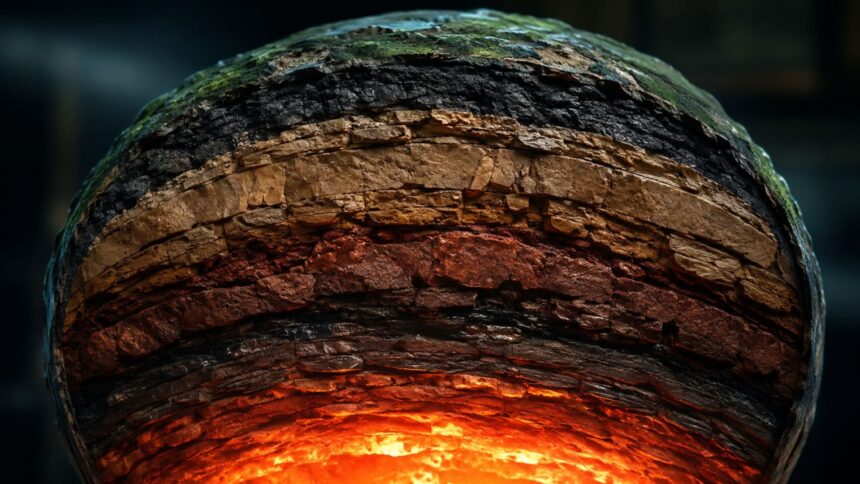
Every rock, storm, and mineral deposit follows a small set of rules — once you see the rules, the rest of the subject stops feeling like memorization.
Most people encounter Earth science as a list of vocabulary words to memorize before a test: lithosphere, sediment, isobar, subduction. Learned that way, none of it sticks, because the words are describing a system, not a glossary. The planet is doing something specific in every one of those definitions — moving heat around, recycling rock, and cycling water between ocean, air, and ground — and once that system is visible, the vocabulary stops needing to be memorized at all.
This is a plain walkthrough of that system: what the Earth is actually made of, why its surface keeps moving, how rock becomes rock again after being destroyed, and how weather and climate are not the same question asked twice. It’s written to be useful whether you’re studying for an exam, curious after a news story about an earthquake, or trying to understand why the ground under a mine or a farm behaves the way it does.
The short answerEarth is a layered planet — core, mantle, crust — driven by internal heat that moves the crust’s plates a few centimeters a year, which builds mountains and triggers earthquakes. Surface rock is destroyed and rebuilt continuously through the rock cycle, while a separate, faster system — the water cycle and atmosphere — governs weather day to day and climate over decades.
01What’s Actually Underneath You Right Now
Stand still for a moment and there are, depending on where you are, somewhere between 5 and 70 kilometers of solid rock directly beneath your feet before the mantle begins. That thin shell is the crust, and it is the least of the planet’s mass — Earth is built in concentric layers, and almost all of its material is not the ground people think of as “the Earth” at all.
| Layer | Approx. Depth | State | Main Composition |
|---|---|---|---|
| Crust | 0–70 km | Solid | Basalt (oceanic), granite (continental) |
| Upper Mantle | 70–670 km | Solid / plastic flow | Peridotite, silicate minerals |
| Lower Mantle | 670–2,890 km | Solid, slow-flowing | Dense silicates, oxides |
| Outer Core | 2,890–5,150 km | Liquid | Iron, nickel |
| Inner Core | 5,150–6,371 km | Solid | Iron, nickel (under extreme pressure) |
The boundary that matters most for everyday geology is the one between the rigid outer shell — crust plus the very top of the mantle, together called the lithosphere — and the softer, slowly deformable mantle layer beneath it, the asthenosphere. The lithosphere doesn’t sit still on top of that layer. It’s broken into pieces, and those pieces move.
Quick Reference
- Earth’s radius: roughly 6,371 km, measured to the center of the inner core.
- The crust makes up under 1% of Earth’s total volume.
- The outer core’s liquid iron motion generates Earth’s magnetic field.
- Continental crust (granite-rich) is older and less dense than oceanic crust (basalt-rich).
- Mantle material can flow over geologic time despite being technically solid.
02Why the Ground Moves: Plate Tectonics in Practice
Heat from the core and from the slow decay of radioactive elements in the mantle has to go somewhere, and it escapes toward the surface as convection — hot material rising, cooling, and sinking again, the same principle that moves a pot of simmering soup. That circulation drags the lithosphere’s plates along with it, at rates comparable to how fast a fingernail grows, which sounds negligible until it’s compounded over tens of millions of years.
Where plates interact, three things can happen, and each produces a distinct kind of landscape:
- Divergent boundaries — plates pull apart, magma rises to fill the gap, and new crust forms. The Mid-Atlantic Ridge is the clearest ongoing example.
- Convergent boundaries — plates collide. One may be forced beneath the other (subduction), producing volcanic arcs and deep ocean trenches, or two continental plates may crumple upward, which is how the Himalayas are still gaining height today.
- Transform boundaries — plates grind past each other sideways without creating or destroying crust. California’s San Andreas Fault is the standard example, and it’s why that region has frequent earthquakes without matching volcanic activity.
The theory of plate tectonics, formalized in the late 1960s, replaced decades of competing explanations for mountain-building and earthquakes with a single mechanical framework — one of the clearer cases in the sciences of many separate observations converging on one underlying cause.
03The Rock Cycle: Nothing Is Permanent, Everything Is Reused
Rock is often taught as three static categories — igneous, sedimentary, metamorphic — as if each rock has always belonged to its group. In practice, those are three stages of the same material moving through a cycle with no fixed starting point.
Molten rock cools into igneous rock (granite, basalt). Exposed at the surface, that rock is broken down by weathering, and the resulting sediment compacts and cements into sedimentary rock (sandstone, limestone, shale). Buried deep enough to experience intense heat and pressure without melting, either type transforms into metamorphic rock (marble from limestone, slate from shale). And if any of the three is driven deep enough to melt, it becomes magma again, ready to restart the cycle as new igneous rock.
Nothing in that description implies a starting point, because there isn’t one — the cycle has been running since the crust first solidified, and every rock formation visible today is mid-cycle.
Why This Actually Matters Outside a Classroom
The rock cycle isn’t trivia. It’s the reason coal, oil, and metal ores exist in the concentrations they do — sedimentary basins slowly compress organic material into fossil fuels, while heat and fluid movement through fractured rock concentrate metals like gold, copper, and silver into ore deposits worth extracting. Mining and energy exploration are, functionally, applied rock-cycle geology: finding the specific point in the cycle where a resource has been concentrated enough to be worth reaching.
04Weather, Climate, and the Water Cycle: Three Different Timescales, One System
Weather and climate get conflated constantly, and the confusion causes real misunderstandings. Weather is the atmosphere’s condition at a specific place and moment — today’s rain, this week’s heatwave. Climate is the long-run statistical pattern of that weather over roughly 30 years or more. A single cold week says nothing about climate, in the same way a single at-bat says nothing about a batting average.
Both are powered by the same underlying process: solar energy heating the Earth unevenly, which drives air pressure differences, which drives wind, which drives the movement of moisture. That moisture itself follows the water cycle — evaporation from oceans and lakes, condensation into clouds, precipitation back to the surface, and runoff or infiltration that eventually returns water to the sea. It’s a closed loop; the planet is not gaining or losing water, only moving it between reservoirs at different rates, from a rainstorm lasting hours to groundwater that can take centuries to resurface.
Weather vs. Climate, in One Line Each
- Weather: what the atmosphere is doing right now, at a specific place.
- Climate: the long-term average and range of that weather over decades.
- Water cycle: the physical mechanism — evaporation, condensation, precipitation, runoff — that supplies both.
05From Rock to Resource: The Business End of Earth Science
Earth science stops being academic the moment it intersects with anything extracted from the ground — and that’s most of the physical economy. Precious metals, industrial minerals, groundwater, and fossil fuels are all products of the same slow geologic processes covered above, concentrated by specific conditions into deposits worth locating and extracting.
Gold, for instance, is typically concentrated by hydrothermal fluids moving through fractured rock over millions of years, depositing metal into veins as conditions change — which is why gold deposits cluster along old fault systems and volcanic belts rather than appearing randomly. Understanding that formation process is exactly how modern exploration geology narrows a search area from a country down to a viable claim.
The same logic applies to rare earth elements and battery metals like lithium and cobalt, which have become strategically important as demand for electronics and energy storage has grown. Their supply is fundamentally a geology problem before it’s an economic or political one: these elements exist in specific rock types, in specific concentrations, in specific places, and no amount of demand changes where the deposits physically are.
06Common Questions, Answered Directly
What is the difference between the lithosphere and the crust?
The crust is Earth’s outermost rock layer alone. The lithosphere is the crust plus the rigid uppermost part of the mantle beneath it, all moving together as a single rigid unit — it’s the lithosphere, not just the crust, that’s divided into tectonic plates.
Why does the mantle behave like a solid and a fluid at the same time?
Mantle rock is solid under normal timescales but deforms and flows extremely slowly under sustained heat and pressure over millions of years, similar to how glacial ice flows. It is solid in the way that matters for a human lifetime and fluid in the way that matters for geologic time.
What actually causes an earthquake?
Earthquakes happen when stress builds along a fault line as tectonic plates try to move past, toward, or away from each other, and rock suddenly slips to release that stress. The released energy travels as seismic waves, which is what’s felt as shaking at the surface.
Is climate change part of Earth science?
Yes — climate is one of Earth science’s core subfields, studied through atmospheric chemistry, ocean circulation, and long-term temperature and ice-core records. Current climate change is distinguished from natural climate variability by its pace and by direct measurement of rising greenhouse gas concentrations.
How is sedimentary rock different from igneous rock?
Igneous rock forms directly from cooled molten material, while sedimentary rock forms from compacted and cemented fragments of older rock, minerals, or organic material. Sedimentary rock is the only major rock type that commonly contains fossils, since the process doesn’t involve melting.
The Planet Isn’t Static — It Just Moves on a Timescale Humans Don’t Notice
The recurring theme across every branch of Earth science is that nothing described here is finished. Plates are still moving, rock is still cycling, water is still evaporating and falling again, and mineral deposits are still forming somewhere right now, exactly as they have for billions of years. The subject feels static in a textbook only because a human lifespan is too short to watch the process run. Once that scale is accounted for, the planet stops looking like a fixed object and starts looking like what it actually is: a system in continuous, patient motion.
Further Reading
EDITORIAL NOTE — This explainer covers established, verifiable Earth science concepts for general educational reading. It is not affiliated with, and does not reproduce material from, any specific coursework platform, textbook, or assessment provider. Figures and depth ranges are commonly cited approximations from geological reference sources and may vary slightly between publications.