

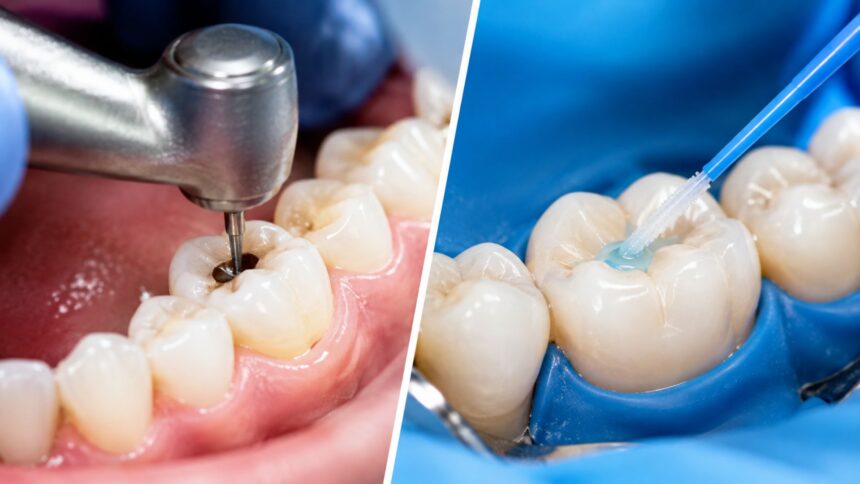
For millions of people, the worst part of a dental appointment is the sound of the drill getting closer.
Now for the good news: a major U.S. clinical trial has found that a liquid painted directly onto a decayed tooth can stop many childhood cavities—without drilling, injections or sedation.
It does not eliminate every filling. But it could dramatically change how dentists manage decay, especially in young children and people who struggle with traditional dental procedures.
The End of the Dental Drill?
Traditional cavity treatment follows a familiar routine: numb the area, drill away the damaged tooth and replace the missing section with filling material.
The treatment works, but it can be frightening, uncomfortable and difficult for very young children.
That is why scientists have been searching for ways to stop decay while preserving more of the natural tooth.
The latest breakthrough involves 38% silver diamine fluoride, or SDF. In a Phase III trial involving 830 children ages 1 to 6, one application arrested 54% of treated lesions after six months, compared with 22.5% in the placebo group.
The procedure can take roughly a minute and requires only a tiny applicator.
There is one important drawback: the decayed area permanently turns dark or black. SDF is currently cleared in the United States for tooth sensitivity, while its use for stopping cavities remains off-label as regulators consider stronger evidence.
3 Scientific Breakthroughs Reversing Cavities Naturally
[Insert High-Res 1200px Image: Three-part scientific illustration showing SDF liquid, a peptide scaffold and stem cells rebuilding tooth dentin]
These treatments do not all literally “reverse” a fully formed hole. Instead, they use different strategies to arrest decay, remineralize early damage or activate the tooth’s own repair system.
Silver Diamine Fluoride—the Magic Liquid
SDF combines two powerful ingredients.
Silver fights cavity-causing microbes, while fluoride helps strengthen weakened tooth material.
A dentist dries the tooth and paints on a tiny amount. No drilling is needed, and the application itself takes only seconds.
However, SDF stops the disease rather than rebuilding the tooth’s missing shape. Some patients may eventually need a filling or crown for appearance, strength or normal chewing function. Repeat applications and dental monitoring may also be necessary.
Peptide Gels—the 3D Web
Treatments containing the self-assembling peptide P11-4, including Curodont products, work differently.
The peptide enters an early enamel lesion and forms a microscopic 3D web. This scaffold gives calcium and phosphate from saliva a place to gather and form new mineral crystals.
Think of it like placing a tiny climbing frame inside a weak spot so the tooth’s minerals can rebuild around it.
Clinical trials have found that P11-4 can reduce the size and activity of early white-spot lesions. But it is intended for early, non-cavitated decay, not large holes or badly infected teeth.
Stem Cell Stimulation—Tideglusib
The most futuristic idea involves tideglusib, a drug previously studied for neurological conditions including Alzheimer’s disease.
Researchers placed very small amounts of the drug inside damaged mouse teeth. It activated a repair pathway and encouraged cells within the dental pulp to produce new dentin—the hard layer beneath enamel.
After several weeks, new dentin filled much of the experimentally created damage.
But this is crucial: tideglusib is not an approved cavity treatment and has not become routine human dental care. The strongest published tooth-repair results remain preclinical.
Can Anyone Get This Treatment?
SDF may be especially helpful for:
- Babies and young children
- People with severe dental anxiety
- Older adults with root decay
- Patients with disabilities or difficulty tolerating drilling
- People needing temporary control before restorative treatment
Peptide treatments are most useful when decay is discovered early, before the enamel collapses into a large cavity.
Deep decay, abscesses or infection reaching the tooth’s nerve may still require a filling, crown, root canal or extraction. A dentist must examine the tooth to determine which option is safe.
What This Means for Your Next Dentist Visit
Dentistry is slowly shifting from “drill and fill” to “heal and seal.”
The biggest change is not that dental drills will disappear tomorrow. It is that dentists now have more ways to catch decay early, stop it from spreading and preserve natural tooth structure.
The earlier a cavity is found, the greater the chance that a painless, minimally invasive treatment may work.
Would you choose a black-staining liquid over a dental drill? Leave a comment—and share this article with someone who hates going to the dentist.