
A budget projector brand with a genuinely useful feature set — and a spec sheet that needs a translator.
If you’ve searched “EGJSG mini projector review,” you’ve probably already seen the number that stops most shoppers mid-scroll: 16,000 lumens. That figure sounds like small-cinema brightness for the price of a nice pair of headphones. It isn’t real in any way that matters for how bright the picture actually looks on your wall, and that gap between marketing copy and lived experience is really the whole story of this brand.
EGJSG isn’t one projector — it’s a lineup of similarly styled budget models (sold under names like the “One-Button Focus,” “Electric Focus,” and USB-C “Navy Blue” units) that show up on Amazon, Walmart, Newegg, and the brand’s own site with overlapping but not identical specs. That matters because “the EGJSG projector” you find in one review may not be the exact SKU you click “buy” on.
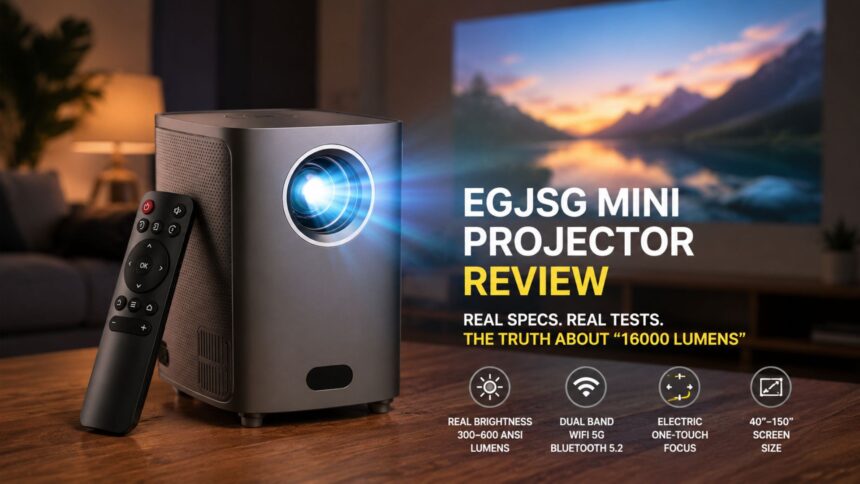
Bottom line: The EGJSG Mini Projector is a native 720p LCD projector (some listings claim 1080p native resolution, which is not consistent across the lineup) that accepts 1080p and marketing-labeled “4K” input, uses electric one-button focus instead of a manual ring, and connects over dual-band WiFi and Bluetooth 5.2 for phone mirroring. Real-world brightness is closer to the 300–600 ANSI lumens range typical of budget mini projectors, not the inflated “16000 lumens” figure printed on some listings — a marketing-lumens number, not an ANSI-lumens number, and the two are not interchangeable.
Why the Lumens Number on the Box Is Misleading You
This is the single most important thing to understand before buying any budget projector, not just this one. “16000 lumens” as used in cheap-projector marketing is an unregulated, self-reported figure that has no standardized relationship to actual screen brightness. The industry-standard measurement, ANSI lumens, is measured with a calibrated light meter under controlled conditions. One hands-on test of an EGJSG model found real output around 350 ANSI lumens — usable in a dim room with curtains drawn, not something that competes with ambient daylight.
For comparison, entry-level “true” ANSI-rated home projectors from established brands typically start around 300–800 ANSI lumens at this price tier, so EGJSG isn’t necessarily worse than its budget peers — it’s just labeled in a way that makes direct comparison shopping nearly impossible unless you know to discount the printed number.
What You’re Actually Getting: Specs at a Glance
| Spec | What EGJSG Lists | What It Means in Practice |
|---|---|---|
| Native resolution | 720p (1280×720) on most SKUs; some listings claim native 1080p | Accepts 1080p/4K files but doesn’t display true 1080p/4K detail |
| Brightness | “16000 lumens” (marketing) | Real-world output likely in the ~300–600 ANSI lumen range |
| Contrast ratio | 5000:1 | Reasonable for the price; blacks won’t be deep |
| Connectivity | Dual-band 2.4G/5G WiFi, Bluetooth 5.2 | Supports wireless phone/laptop screen mirroring, external Bluetooth speaker pairing |
| Focus | Electric “2-second” one-button focus | No manual focus ring to fiddle with |
| Keystone correction | Automatic vertical keystone (up to roughly ±15° on some models) | Helps when the projector isn’t perfectly level with the screen |
| Screen size | 40″–150″ (some listings: up to 300″) | Image quality softens noticeably at the larger end |
| Charging | USB-C on some SKUs | Can run off a high-capacity power bank for outdoor use |
| Lamp life | Around 60,000 hours (manufacturer claim) | Standard LED-lamp claim for this category |
| Price | Roughly $40–$130 depending on model and retailer | Newegg listed one SKU at $126.99; other listings run lower |
The Genuinely Good Part: Setup and Streaming Just Work
Across multiple independent hands-on write-ups, the recurring praise isn’t about picture brightness — it’s about how little friction there is to get watching something. Reviewers consistently called setup simple, said the electric focus saved real time compared to a manual ring, and reported smooth phone- and laptop-screen mirroring without noticeable lag, including one tester who ran a two-hour movie mirrored from a MacBook with no dropped frames.
That’s a meaningful selling point for a category where fiddly manual focus rings and unreliable WiFi mirroring are common complaints on far more expensive budget projectors.
Where It Falls Short
- Ambient light kills it. Every review, without exception, notes the image only really looks good with the lights off or the room already dim. Don’t plan on backyard movie night before full dark.
- Built-in speakers are an afterthought. Reviewers describe the onboard audio as “okay” at best, and the Bluetooth pairing feature — including the ability to pair two Bluetooth speakers in stereo — exists largely because EGJSG expects you’ll want external sound anyway.
- Resolution claims aren’t consistent brand-to-brand. Because “EGJSG” covers several distinct SKUs sold through different storefronts, some product pages call the panel native 1080p while independent reviews describe it as native 720p with 1080p input support. Check the exact listing you’re buying, not just the brand name.
- “4K supported” means input compatibility, not 4K resolution. The projector can accept and downscale a 4K source file; it cannot display 4K detail on a 720p or 1080p panel.
Frequently Asked Questions
Is the EGJSG Mini Projector actually 16,000 lumens?
No. That figure is a marketing lumens rating, not an ANSI lumens measurement, and the two scales aren’t comparable. Independent testing of an EGJSG model measured real brightness closer to 350 ANSI lumens, which is typical for a budget mini projector, not exceptional.
Does the EGJSG projector support 4K?
It supports 4K video files as an input source but does not natively display 4K resolution. The panel itself is 720p or 1080p depending on the specific model, so 4K content is downscaled for playback.
What’s the maximum usable screen size?
EGJSG lists a range of roughly 40 to 150 inches (some SKUs advertise up to 300 inches), with an optimal projection distance of about 1 to 4 meters. Image sharpness and brightness both decline noticeably as you push toward the larger end of that range.
Can I use the EGJSG projector outdoors during the day?
Not effectively. Every hands-on review notes the picture is only clearly visible in dim or dark conditions, which rules out daytime outdoor use and limits it mostly to evening or indoor darkened-room viewing.
Does it need external speakers?
Not strictly, but most reviewers recommend them. The built-in speakers are functional for casual, quiet-room viewing but are described as underwhelming for movie night; the Bluetooth 5.2 connection makes pairing an external speaker or soundbar straightforward.
How much does it cost?
Pricing varies by specific model and retailer, roughly $40 to $130. A Newegg listing for one “One-Button Focus” SKU was priced at $126.99, while other EGJSG models are listed lower on Amazon and Walmart-adjacent marketplaces.
The Actual Verdict
Judge the EGJSG Mini Projector by what it’s designed to be — a sub-$150 casual-use projector for a dark bedroom, a dorm room, or an evening backyard hangout — and it holds up reasonably well for the category. Judge it by the number printed on the box, and you’ll be disappointed the first time you turn on a lamp. The electric focus and wireless mirroring are legitimately convenient; just buy it with the same brightness expectations you’d have for any other projector in this price bracket, and go straight to external speakers if sound quality matters to you.
Sources & Verification
- EGJSG official product listing — manufacturer specs and claims
- Newegg listing — pricing and specs for the One-Button Focus model
- Amazon listings for multiple EGJSG SKUs (Electric Focus, One-Button Focus, USB-C Navy Blue models)
- Independent hands-on reviews from TVsBook and itsreleased.com covering real-world ANSI lumens testing and streaming performance
- ownpetz.com projector review roundup
A note on this review: EGJSG sells several distinct projector models under overlapping marketing names, and specs (especially native resolution and brightness) are not consistent across every listing. Where sources conflicted, this article notes the discrepancy rather than picking one figure to state as fact. Always check the exact product page and model number before purchasing.