

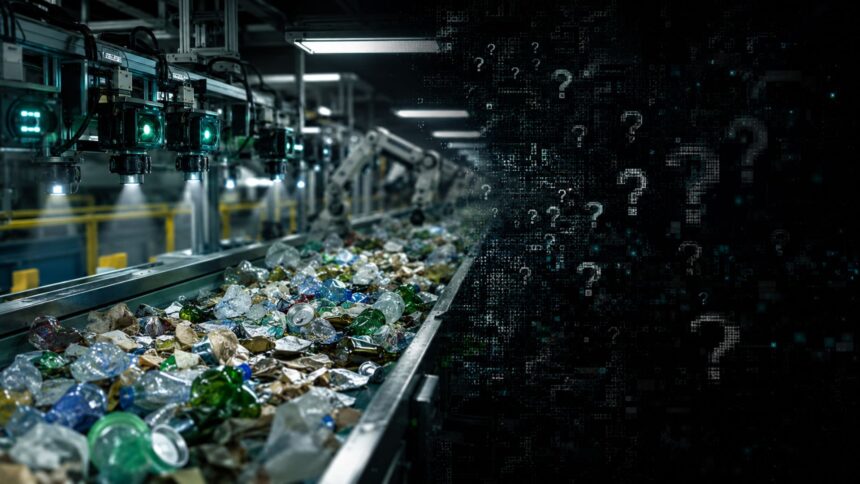
The name sounds like a breakthrough in automated waste sorting, yet the available evidence points to something far less concrete.
Search for MataRecycler, and a polished technological story quickly appears: artificial intelligence recognizes discarded objects, smart sensors monitor bins, robotic equipment separates materials, and cloud dashboards track every item.
Some articles go further, attaching precise-looking claims about sorting accuracy, cost reductions, recycling rates, mobile applications, and smart-city deployments.
There is one major problem. The official MataRecycler pages reviewed do not identify a recycling-machine manufacturer, software company, engineering team, commercial product, pilot facility, mobile application, patent portfolio, or independently audited performance report. Instead, they describe MataRecycler as an informational platform publishing content about recycling, sustainability, technology, and other general-interest subjects.
MataRecycler is currently best verified as the name of general-interest information websites—not as a documented manufacturer or deployed AI recycling platform. Claims involving smart bins, 95%–98% accuracy, mobile apps, municipal pilots, and major cost savings remain unsupported by identifiable primary technical evidence.
What MataRecycler Actually Says About Itself
The strongest starting point is not a third-party explainer. It is MataRecycler’s own published description.
MataRecycler.com calls itself a platform devoted to recycling information, sustainable practices, and environmental awareness. Its stated mission is to make recycling guidance accessible to individuals, businesses, and communities. The accompanying disclaimer says its material is provided for general informational and educational purposes.
A separate domain, MataRecycler.org, similarly describes itself as a digital magazine or information website covering sustainable recycling and technology updates. Its indexed sections also contain articles about entertainment, fashion, gaming, business, software, finance, and lifestyle—not simply waste-processing engineering.
That distinction matters.
A website can promote recycling awareness without manufacturing recycling hardware. It can discuss artificial intelligence without operating an AI platform. It can publish sustainability articles without owning collection trucks, processing plants, smart bins, optical sorters, or robotic arms.
MataRecycler Verification Snapshot
- Verified identity: Online information and publishing brand
- Published focus: Recycling, sustainability, technology, and general-interest content
- Commercial hardware: No confirmed product catalogue located
- Software platform: No verified public application or customer dashboard located
- Named founders: Not clearly disclosed on the reviewed official pages
- Engineering documentation: No technical white paper located
- Pilot installations: No independently documented city or facility identified
- Pricing: No confirmed equipment or software pricing published
- Performance testing: No independently audited results located
- Current evidence level: Content platform confirmed; AI recycling product unconfirmed
How an Information Brand Became an “AI System” Across the Web
During 2026, numerous articles began describing MataRecycler as an integrated waste-management system involving computer vision, sensors, Internet of Things connectivity, cloud analytics, smart bins, robotic sorting, and consumer rewards.
Several versions repeat specific performance ranges, including claims of 95% to 98% sorting accuracy and significant reductions in landfill expenses. One article even says its writer tested a demonstration unit, but it does not identify a model number, testing location, manufacturer, engineering contact, test protocol, raw dataset, or purchasing channel.
The problem is not that such technology is impossible.
The problem is that the claims are disconnected from the evidence normally attached to a real industrial product:
- A registered operating company
- Named executives and engineers
- Product documentation
- Installation photographs with identifiable customers
- Safety and compliance certifications
- Throughput measurements
- Material-specific accuracy reports
- App-store listings
- Procurement records
- Patents or published research
- Funding announcements
- Verified customer case studies
No single missing item proves that a product is fictional. The combined absence of nearly all of them, however, substantially lowers confidence.
The Claim-to-Evidence Grid
| Online claim about MataRecycler | Evidence normally required | What was located |
|---|---|---|
| AI automatically recognizes waste | Model documentation, training methodology and test results | Generic descriptions in third-party articles |
| Sorting accuracy reaches 95%–98% | Material-level confusion matrix and independent testing | No primary test report located |
| Smart bins transmit real-time data | Hardware specifications, connectivity protocols and installation records | No verified product manual located |
| A mobile app guides users | Developer identity and official app-store listing | No confirmed MataRecycler application located |
| Cities use the system | Named municipality, contract, facility or public case study | No independently documented deployment located |
| Businesses cut landfill costs by 40%–60% | Customer baseline, methodology and audited savings | No attributable financial study located |
| MataRecycler is a recycling company | Corporate registration, team, services and operating locations | Official pages describe informational publishing |
| MataRecycler is a sustainability platform | First-party mission and editorial descriptions | Supported by the official websites |
The Technology Stack a Real MataRecycler Would Require
Although MataRecycler’s claimed architecture is unverified, the underlying engineering concepts are genuine. Modern material-recovery systems can combine spectroscopy, cameras, machine learning, robotics and industrial control systems.
A credible platform matching the descriptions circulating online would require at least six connected layers.
1. Material-Sensing Layer
Visible-light cameras can detect shape, colour, labels and object form. Near-infrared sensors can help distinguish polymers that appear similar to the human eye. Hyperspectral systems collect information across many wavelength bands, making more detailed material characterization possible.
National laboratory research has examined systems combining spectroscopy, computer vision and machine learning to identify municipal waste in real time. Commercial sorting equipment also uses near-infrared spectroscopy and high-resolution imaging to separate polymers and identify contaminants.
2. Classification and Decision Engine
Sensor readings must be passed to trained models that classify each object.
A production system would need to report more than one overall “accuracy” number. Its performance would vary by:
- Plastic resin
- Object colour
- Material cleanliness
- Conveyor speed
- Item overlap
- Lighting conditions
- Packaging deformation
- Moisture
- Contamination level
- Minimum detectable size
Without these breakdowns, a headline accuracy percentage has limited operational meaning.
3. Physical Separation Equipment
Recognition alone does not recycle anything.
After classification, a mechanical system must redirect the item using robotic arms, compressed-air jets, diverters, magnets, eddy-current separators or other industrial equipment. Existing commercial systems use computer vision to guide robots or air nozzles toward selected objects moving along conveyors.
4. Industrial Control and Safety Systems
A functioning installation would need programmable logic controllers, emergency stops, conveyor synchronization, guarding, maintenance procedures and failure-handling rules.
It would also need to address fires, batteries, compressed containers, hazardous objects and materials that could damage equipment or injure workers.
5. Data and Connectivity Platform
The frequently mentioned “cloud dashboard” would require a documented data pipeline covering:
- Sensor ingestion
- Device authentication
- Inventory records
- Fill-level monitoring
- Route planning
- Equipment health
- User permissions
- Cybersecurity
- Data retention
- System uptime
- Environmental reporting
A mobile interface would require its own privacy policy, software publisher, version history, support structure and distribution channel.
6. End-Market Integration
Accurate sorting has value only when recovered material is sufficiently clean, economically transportable and accepted by a buyer.
The U.S. Environmental Protection Agency explains that recyclables are transported to processing facilities, sorted, cleaned of contaminants and prepared for manufacturing or further processing. The success of the system therefore depends on collection rules, processing capacity and demand for recovered commodities—not simply artificial intelligence.
Why the MataRecycler Story Sounds So Convincing
MataRecycler emerged beside a real and urgent problem.
The United Nations Environment Programme projects that municipal solid waste generation could increase from approximately 2.1 billion tonnes in 2023 to 3.8 billion tonnes by 2050. It estimates that waste management’s direct and hidden global costs could rise sharply without stronger prevention, collection and circular-economy measures.
Contamination is also a genuine operational barrier.
An EPA assessment identifies broken glass, difficult packaging, unsupported plastic types and black carbon plastics among the problems affecting recycling streams and optical detection.
Real companies and research institutions are already developing technologies similar to those attributed to MataRecycler:
- Computer-vision recognition
- Near-infrared polymer identification
- Hyperspectral material analysis
- AI-directed robotic arms
- Pneumatic separation
- Automated battery sorting
- Facility-level material analytics
National laboratory research has proposed AI-enabled material-recovery facilities combining visual imaging, hyperspectral imaging, multisensor data and established sorting technologies.
That real technological foundation makes an unsupported product description appear credible. The vocabulary is accurate even when the named platform has not been demonstrated.
Editorial assessment: MataRecycler should not be presented as a proven recycling machine or operational AI company unless primary evidence emerges. The responsible description is an online publishing identity surrounded by speculative or unattributed technology claims.
A Search History With Two Very Different Meanings
The MataRecycler keyword does not appear to have one stable historical definition.
2008–2011: The Recycler-Virus Utility References
Older Spanish-language forum discussions used “MataRecycler” or “MataRecycler.exe” for scripts or utilities intended to remove malware associated with Windows and USB “Recycler” folders. These references are unrelated to sustainability or modern waste processing.
December 2025: The Content-Site Footprint Becomes Visible
Indexed MataRecycler.com posts dated December 2025 cover broad technology and business subjects. The site’s own pages frame the brand as an informational platform rather than an equipment producer.
Early 2026: MataRecycler.org Expands as a Digital Magazine
MataRecycler.org presents recycling as part of a much wider editorial mix containing technology, finance, entertainment, gaming, lifestyle and health content.
June 2026: AI Recycling Claims Multiply
Third-party articles begin describing MataRecycler as a fully developed smart-waste ecosystem, often repeating nearly identical components: cameras, AI sorting, IoT sensors, apps and cloud dashboards.
July–August 2026: Verification Questions Surface
Later articles start distinguishing the confirmed publishing platform from the unsupported AI-product narrative. The central question shifts from “How does MataRecycler work?” to “Does a product by this name actually exist?”
The Seven Checks MataRecycler Still Needs to Pass
Before treating MataRecycler as a commercial recycling technology, readers, journalists and potential buyers should request verifiable answers to seven questions.
Who legally operates it?
A genuine supplier should identify its registered company, headquarters, leadership and customer-support channels.
What can customers purchase?
There should be named products, model numbers, software plans, installation requirements or procurement documentation.
Where is it operating?
A pilot should identify the city, business, materials-recovery facility, university or waste contractor involved.
How was performance measured?
Accuracy should be separated by material class and measured across a disclosed sample size under defined operating conditions.
Who independently evaluated it?
Testing by a university, laboratory, regulator, certification body or named customer carries more weight than unattributed promotional figures.
Where is the technical documentation?
A serious industrial system normally provides manuals, connectivity requirements, safety information, processing capacity and maintenance specifications.
What happens after materials are sorted?
The operator should identify downstream processors and markets. Sorting an object correctly does not guarantee that it will be recycled into a new product.
MataRecycler Questions People Are Asking
What is MataRecycler?
MataRecycler is best verified as an online information and publishing identity focused partly on recycling, sustainability and environmental awareness. Some external articles describe it as an AI-powered recycling system, but the reviewed official pages do not provide sufficient primary evidence of a commercial machine, software platform or deployed smart-bin network.
Is MataRecycler a real company?
MataRecycler has a real online presence, including active websites and published content. However, a verified content website is not the same as a confirmed recycling-technology company. The reviewed pages do not clearly identify a corporate operator, executive team, manufacturing operation, product catalogue, customer deployments or technical support organization.
Does MataRecycler use artificial intelligence?
Articles claim MataRecycler uses computer vision, sensors, cloud analytics and automated sorting. Those features are technically plausible and already exist elsewhere in the recycling industry. Nevertheless, no primary engineering document, independent test, identifiable installation or confirmed product demonstration was located that proves MataRecycler itself operates those technologies.
Is the claimed 95%–98% sorting accuracy verified?
No independently verifiable report supporting that MataRecycler accuracy range was located. A meaningful performance report would need to disclose the tested materials, sample size, conveyor conditions, contamination level, false-positive rate, false-negative rate and evaluator. Without those details, the percentage should be treated as an unsupported promotional claim.
Is MataRecycler an app?
No clearly verified MataRecycler consumer application was located in the reviewed evidence. Third-party descriptions mention mobile scanning, rewards, tracking and recycling guidance, but they do not consistently provide an official developer identity or confirmed app-store listing. The official websites primarily function as publishing platforms.
Is MataRecycler connected to the old Recycler computer virus?
The current recycling-content websites appear unrelated to the older use of “MataRecycler” for utilities designed to remove Windows or USB Recycler malware. Historical forum references show that the same term circulated in a cybersecurity context years before it became associated online with sustainability and smart recycling.
The Real Value of MataRecycler May Be the Question It Forces Us to Ask
MataRecycler captures the exact kind of idea the waste sector needs: better identification, cleaner material streams, faster sorting, stronger public guidance and usable operational data.
But a necessary idea is not automatically a verified product.
Until MataRecycler publishes traceable technical documentation, named deployments, responsible company information and independently testable results, the most accurate description remains modest: MataRecycler is an information brand whose name has become attached to a largely unverified AI-recycling narrative.
The technology described around it is real.
The evidence connecting that technology to MataRecycler is not yet strong enough.
Sources and Verification
- MataRecycler.com, About Us: First-party description of the site as an informational platform promoting recycling and sustainability.
- MataRecycler.com, Disclaimer: States that published material is for general informational and educational purposes.
- MataRecycler.org, About Us: Describes the property as a digital magazine and information website.
- United Nations Environment Programme, Global Waste Management Outlook 2024: Global waste projections and economic-cost modelling.
- U.S. Environmental Protection Agency, U.S. Recycling System: Official explanation of collection, processing, contamination removal and manufacturing pathways.
- EPA Assessment of U.S. Recycling Infrastructure: Evidence concerning contamination and material-sorting challenges.
- National Laboratory research on AI-enabled waste sorting: Technical research involving spectroscopy, computer vision, hyperspectral imaging and automated material identification.
- Commercial sorting-system documentation: Examples of real computer-vision, robotic and near-infrared waste-sorting technologies used for comparison.
Editorial Disclaimer: This article reflects publicly accessible information reviewed as of August 2, 2026. The absence of located evidence does not prove that unpublished technology or private operations do not exist. Claims may require revision if MataRecycler releases verifiable corporate records, technical documentation, independent testing or named deployments.