

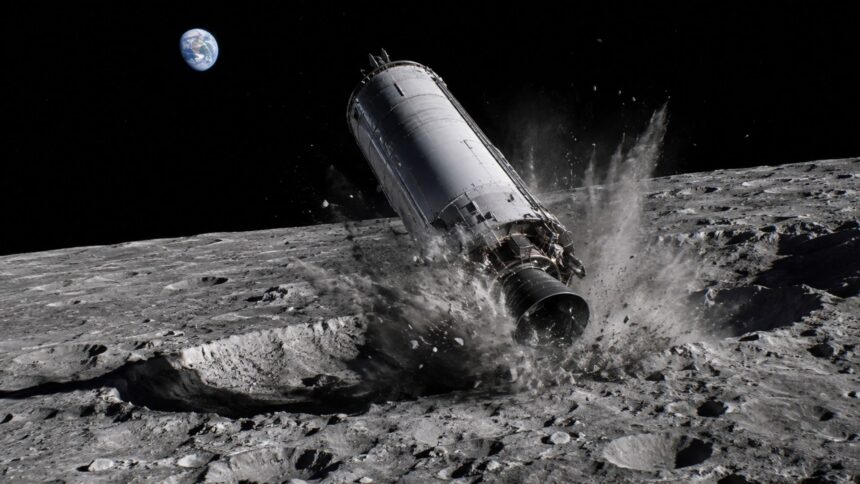
The impact was invisible from Earth, but the crater it may have left points to a bigger problem in deep-space traffic.
A four-tonne piece of a SpaceX Falcon 9 rocket is believed to have crashed into the Moon on August 5, 2026. It was not a failed lander, but a discarded upper stage left drifting after a successful mission.
The collision posed no threat to Earth. NASA now wants to locate the site, study the debris pattern and improve tracking of human-made objects beyond Earth orbit.
A discarded four-tonne Falcon 9 upper stage is believed to have struck the Moon on August 5, 2026, near the Einstein and Bell craters, creating a new crater but posing no danger to Earth, according to NASA’s tracked trajectory data.
What Actually Hit the Moon?
The object was the second stage of the Falcon 9 that launched Firefly Aerospace’s Blue Ghost Mission 1 on January 15, 2025. The lander deployed successfully, but the spent stage remained in deep space rather than returning through Earth’s atmosphere.
| Key detail | Reported figure |
|---|---|
| Object | Falcon 9 upper stage |
| Estimated mass | About four tonnes |
| Impact speed | Roughly 5,400 mph |
| Expected crater | 60 feet wide, 12 feet deep |
The stage was expected to strike near the Einstein and Bell craters at about 6:35am BST. NASA said its Center for Near Earth Object Studies confirmed a 100% probability of lunar impact.
Why the Rocket Stage Came Back
Falcon 9 stages usually re-enter Earth’s atmosphere or fall into the ocean. This mission required extra energy to send Blue Ghost towards the Moon, leaving the upper stage on an uncontrolled path.
NASA says solar activity and gravitational forces gradually reshaped that trajectory until it led back to the Moon. Independent astronomers first identified the collision course using public tracking data.
For broader context on how impacts and rock processes reshape planetary surfaces, Techs Bullion’s Earth science field guide explains the mechanics behind changing rocky worlds.
The Crash Nobody Could Clearly See
The impact was not visible with the naked eye. Its predicted location near the Moon’s edge, plus lighting and weather, also made immediate telescope confirmation difficult.
NASA planned observations using ground-based telescopes, the Lunar Reconnaissance Orbiter and ShadowCam aboard South Korea’s Korea Pathfinder Lunar Orbiter. Images may take several days because spacecraft position, timing and sunlight must align.
Scientists can use the resulting dust and rock ejecta to test impact models and study how lunar material behaves at extreme speed.
A Small Crater With a Bigger Warning
NASA notes that an impact carrying similar energy naturally occurs on the Moon about every six days. The physical damage is minor on a lunar scale.
The bigger issue is management. More commercial missions mean more spent hardware entering complex Earth-Moon orbits. NASA and SpaceX are discussing disposal options that could make future upper-stage endings controlled and easier to track.
Questions People Are Asking
Did a SpaceX rocket crash into the Moon?
A SpaceX rocket stage is believed to have crashed into the Moon. It was the discarded upper stage from the January 2025 Falcon 9 launch carrying Firefly Aerospace’s Blue Ghost lander—not the entire rocket or an active spacecraft.
Was the SpaceX Moon crash dangerous to Earth?
The SpaceX Moon crash was not dangerous to Earth. NASA said the stage’s trajectory ended at the lunar surface, where it was expected to create a modest crater and eject dust without affecting Earth, satellites or people.
Has NASA confirmed the lunar impact?
NASA confirmed that tracking data gave the stage a 100% chance of hitting the Moon, but visual confirmation may take time. Orbiting cameras must compare new images with earlier views to identify the fresh crater.
The Moon Keeps the Evidence
This was a small collision on a heavily cratered world, yet it exposed how difficult deep-space debris can be to predict and manage. The clearest proof may arrive not as dramatic video, but as one fresh scar photographed from lunar orbit.
Disclaimer: Details are based on official tracking, estimates and early reporting. Measurements and confirmation status may change when NASA releases imagery or updated analysis.