

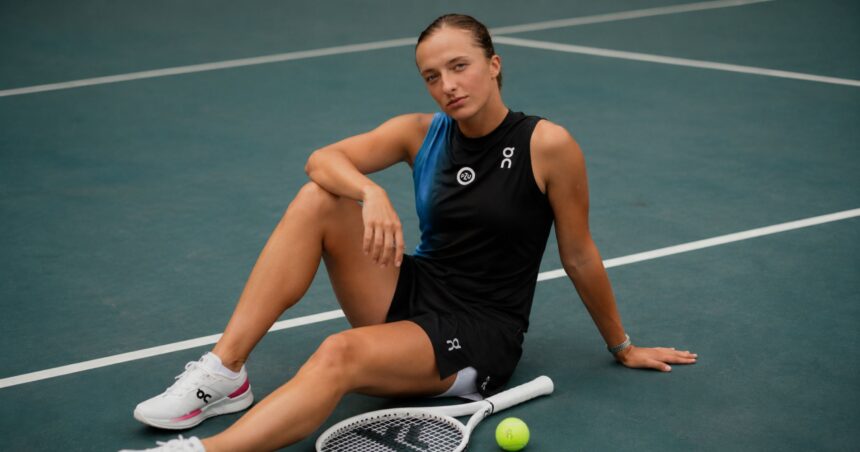
Iga Świątek in 2026: The Titles, Technique, Family and Fortune Behind Poland’s Tennis Standard-Bearer
Six major championships established Iga Świątek as a generational force, but her difficult 2026 season is testing how successfully she can rebuild an already proven game.
Iga Świątek has spent much of her professional life making elite tennis look brutally simple: attack the return, seize the baseline, create a high-bouncing forehand and deny the opponent enough time to breathe. That formula produced four Roland-Garros crowns, a US Open championship and, most unexpectedly, the 2025 Wimbledon title.
The situation looks different in August 2026. Świątek remains one of the sport’s most accomplished active players, yet she has slipped outside the immediate championship pace, changed coaches and entered the North American hard-court swing without a singles title for the season.
That contrast makes her current position more compelling—not because her previous achievements have diminished, but because the next stage of her career may reveal whether she can reconstruct dominance rather than simply recover it.
Iga Świątek is a Polish professional tennis player, six-time Grand Slam singles champion, former world No. 1 and 2024 Olympic bronze medalist. By August 2026, she had won 25 WTA singles titles, earned more than $45.8 million in career prize money and remained the defining clay-court player of her generation.
Iga Świątek at a Glance
| Category | Verified detail |
|---|---|
| Full name | Iga Świątek |
| Date of birth | May 31, 2001 |
| Birthplace | Warsaw, Poland |
| Age in August 2026 | 25 |
| Height | 5 feet 9 inches, or 1.76 metres |
| Playing hand | Right-handed |
| Backhand | Two-handed |
| Career-high singles ranking | World No. 1 |
| Ranking on August 3, 2026 | World No. 8 |
| WTA singles titles | 25 |
| Grand Slam singles titles | 6 |
| Olympic medal | Bronze, Paris 2024 |
| Current coach | Francisco Roig |
| Career prize money through August 3, 2026 | $45,886,549 |
The WTA’s August 2026 records list Świątek at No. 8 with a 23–12 season record, no 2026 singles titles and $2,246,059 in year-to-date prize money. The same official profile records 25 career singles trophies and a career-high ranking of No. 1.
A 2026 Ranking Dip That Changes the Question Around Świątek
Calling Świątek’s 2026 season a collapse would be inaccurate. Calling it ordinary by her standards would be fair.
She began the year ranked No. 2 and helped Poland win its first United Cup title. The individual results that followed, however, did not match her usual rate of conversion. She reached several quarterfinals, lost her opening match in Miami to fellow Pole Magda Linette and separated from coach Wim Fissette in March. Francisco Roig, previously a long-serving member of Rafael Nadal’s coaching team, joined her shortly afterward.
Her 2025 Wimbledon triumph had seemingly resolved the largest technical question attached to her career: whether her extreme forehand grip and clay-oriented movement patterns could withstand the lower bounce and shortened reaction time of grass. Twelve months later, her title defence ended in the third round when Alexandra Eala defeated her 7–6(9), 6–2.
By August 3, the WTA listed Świątek at No. 8 with a 23–12 record and no singles trophy for the season. Rankings fluctuate weekly, but that position represented a substantial change for a player who spent 125 total weeks at No. 1 and remained inside the Top 2 for 173 consecutive weeks before falling to No. 5 in 2025.
The central question is therefore no longer whether Świątek can win outside Paris. She has already won major titles on clay, grass and hard courts. The question is whether her revised technical structure can restore the clarity, acceleration and confidence that previously made her nearly impossible to contain.
Raszyn’s Competitive Household: An Olympian Father, a Medical Family and an Older Sister to Chase
Świątek was born in Warsaw and grew up in the nearby Polish town of Raszyn. Publicly documented information establishes her Polish family background, although detailed claims about ancestry extending beyond her immediate family have not been substantiated by authoritative biographical records.
Her father, Tomasz Świątek, competed for Poland in the men’s quadruple sculls rowing event at the 1988 Seoul Olympic Games. Rather than directing both daughters toward team sports, he encouraged them to participate in individual competition, where preparation and personal performance would have greater influence over results.
Her mother, Dorota Świątek, worked as an orthodontist. Iga’s older sister, Agata, initially played tennis and competed briefly at junior level before injuries interrupted that path. Agata later entered dentistry, following the medical direction of their mother.
Iga did not begin tennis because a scouting system identified her as a future major champion. She followed Agata into the sport and has repeatedly described a simple childhood motivation: she wanted to beat her older sister. The WTA includes that sibling rivalry in its official biography.
School Had to Survive the Tennis Calendar
Education remained a serious family requirement even after Świątek’s results began accelerating. In a WTA interview published before her breakthrough, she explained that her parents had taught both daughters to put school before tennis. She completed her Polish secondary-school examinations in 2020, including advanced mathematics and English.
There is no verified record of Świątek completing a university degree. Her professional schedule expanded almost immediately after secondary school: only months after finishing her exams, she won Roland-Garros at 19.
The timing mattered. Until that victory, Świątek had been managing two demanding identities—a full-time student and a developing tour professional. Finishing school gave her the opportunity to build a calendar entirely around training, recovery and competition just as her career entered its fastest phase.
Why Her Forehand Jumps Differently—and Why Fast Courts Can Challenge It
Świątek is officially listed as a 1.76-metre right-handed player. Those basic measurements reveal little about what separates her game from a conventional power baseliner. Her advantage comes from the interaction of spin, foot speed, court position and return pressure.
Her forehand is constructed with an unusually strong Western grip. Roland-Garros technical analysis has measured the shot above 3,400 revolutions per minute in some conditions, while WTA analysis has placed her average near 3,200 rpm. Those figures are exceptional in women’s tennis and produce a ball that rises sharply after landing.
On clay, the surface magnifies the effect. The ball slows after contact with the court but continues climbing, forcing opponents to strike above their preferred contact point. Świątek then uses her speed to recover toward the centre, take the next ball early and redirect play before the opponent can regain neutral positioning.
Her return game compounds the pressure. She frequently begins rallies with an aggressive first strike rather than treating the return as a defensive shot. Once she moves inside the baseline, opponents can be trapped several metres behind it, defending increasingly difficult angles.
The Same Forehand Has a Built-In Trade-Off
The technique is not mechanically effortless. An extreme grip requires exact spacing and rapid preparation. On a quick court, a flat ball arriving through the strike zone can reduce the time available to create the full upward swing. Big hitters who rush Świątek’s forehand or prevent her from setting her feet can expose that tension.
Grass once represented the clearest version of the problem. The lower bounce left less room beneath the ball, while abrupt changes of direction challenged movement habits developed for clay. Work under Wim Fissette adjusted her positioning, serve and willingness to shorten points, contributing to the 2025 Wimbledon championship.
Her 6–0, 6–0 victory over Amanda Anisimova in that final secured a sixth major and made Świątek the youngest woman since Serena Williams in 2002 to win Grand Slam singles championships on all three surfaces.
“It’s those who can mentally cope with the most stressful moments who are the champions.” — Iga Świątek
Six Majors, 25 Titles and the Seasons That Built the Record
Świątek’s professional progress was unusually compressed. She won her first ITF event in 2016, became a junior Wimbledon champion in 2018 and reached her first WTA final in Lugano in 2019. By October 2020, she was a Grand Slam champion.
| Year | Defining development |
|---|---|
| 2016 | Won an ITF $10,000 event in Stockholm on her professional debut |
| 2018 | Won the Wimbledon girls’ singles title |
| 2019 | Reached the Lugano WTA final and entered the Top 100 |
| 2020 | Won Roland-Garros without losing a set |
| 2021 | Won Adelaide and Rome; reached the Roland-Garros doubles final |
| 2022 | Became world No. 1, produced a 37-match winning streak and won Roland-Garros and the US Open |
| 2023 | Won Roland-Garros and the WTA Finals; finished year-end No. 1 |
| 2024 | Completed three consecutive Roland-Garros victories and won Olympic bronze in Paris |
| 2025 | Won Wimbledon, Cincinnati and Seoul, reaching six major titles and 25 WTA singles trophies |
| 2026 | Changed coaches, fell to No. 8 and remained without a singles title through August 3 |
The underlying career chronology and title totals are recorded by the WTA and ITF.
Roland-Garros 2020 Changed Polish Tennis
Świątek entered the 2020 French Open ranked No. 54. She did not lose a set, defeated Sofia Kenin in the final and became the first Polish player—male or female—to win a Grand Slam singles championship.
At 19 years and 132 days, she was the youngest women’s champion in Paris since Monica Seles in 1992. She was also the lowest-ranked women’s Roland-Garros champion of the Open Era.
That victory was not followed by an immediate march to No. 1. Her 2021 season was productive rather than dominant: she won Adelaide and Rome, reached the Roland-Garros singles quarterfinals and finished runner-up in the Paris doubles competition with Bethanie Mattek-Sands.
The 37-Match Sequence That Reordered the Tour
Świątek’s elevation accelerated in 2022 after Ashleigh Barty retired while holding the No. 1 ranking. Świątek earned the top position on April 4 and validated it by winning Miami, completing the “Sunshine Double” after her Indian Wells championship.
Her winning sequence reached 37 matches, the longest WTA streak of the 21st century at the time. The run included six consecutive titles and ended only at Wimbledon. She later won the US Open, giving her major trophies on two surfaces before turning 22.
Paris Became Her Private Territory
Świątek captured Roland-Garros in 2020, 2022, 2023 and 2024. The latter three formed a consecutive title sequence, reinforcing the view that beating her on Court Philippe-Chatrier had become one of the most difficult assignments in professional tennis.
The combination of topspin, lateral movement and return quality produced an especially wide competitive margin on clay. Her ability to win sets 6–0—commonly described as delivering a “bagel”—also became a visible statistical feature of her dominance rather than an occasional anomaly.
Paris 2024 Produced Poland’s First Olympic Tennis Medal
Świątek entered the Paris Olympics as the leading favourite on the same courts used for Roland-Garros. A semifinal loss ended her gold-medal pursuit, but she defeated Anna Karolína Schmiedlová 6–2, 6–1 in 59 minutes to claim bronze.
It was Poland’s first Olympic tennis medal of any colour.
Coaches, Psychology and the Contamination Case That Tested Her Reputation
Świątek’s career has been shaped by relatively long coaching partnerships rather than constant turnover.
Piotr Sierzputowski guided her through junior development and the 2020 French Open breakthrough. Tomasz Wiktorowski took over before the 2022 season and oversaw the rise to No. 1, the 37-match streak and four of her first five major championships. Their partnership ended in October 2024.
Wim Fissette joined later that month. His technical brief included making Świątek less dependent on clay-oriented patterns, improving the serve and creating solutions for faster surfaces. The partnership produced Wimbledon, Cincinnati and Seoul titles in 2025 but ended after a difficult opening phase of 2026.
Francisco Roig joined in April 2026. Roig spent many years working alongside Rafael Nadal, Świątek’s childhood tennis reference, and brought extensive experience with high-spin baseline tennis. The appointment suggested a desire to restore the physical and technical identity behind her clay dominance while retaining the faster-court additions made under Fissette.
Mental Training Is Part of the Performance System
Sports psychologist Daria Abramowicz became one of the most recognisable members of Świątek’s support team during her rise. Their work helped normalise the presence of a psychologist in an elite player’s travelling team rather than treating mental preparation as emergency support.
Świątek’s between-point routines, breathing patterns and deliberate match preparation reflect that integrated approach. It does not make her immune to anxiety or expectation. Instead, it gives her a repeatable process for managing them.
That distinction became especially important once she carried both the No. 1 ranking and the public expectations of a country that had never previously produced a Grand Slam singles champion.
What the 2024 Anti-Doping Decision Actually Established
In August 2024, an out-of-competition sample returned a positive result for trimetazidine. Świątek accepted a one-month suspension under the Tennis Anti-Doping Programme.
The International Tennis Integrity Agency accepted that the substance originated from contamination in a regulated melatonin medication obtained in Poland and that the violation was not intentional. Her provisional suspension from September 12 to October 4 counted toward the sanction, leaving eight additional days to serve. She also forfeited prize money from the Cincinnati tournament immediately following the test.
The episode remains part of her official record and should not be erased from a complete biography. It should also not be inaccurately described as a finding of deliberate performance enhancement; the responsible authority explicitly accepted the contaminated-medication explanation.
Financial Trajectory: Prize Money Is Verifiable, Net Worth Is Not
The cleanest measure of Świątek’s financial career is official tournament prize money.
The WTA’s career earnings list dated August 3, 2026 credits her with $45,886,549, placing her third in women’s tennis history at that date—behind Serena Williams and Aryna Sabalenka, and ahead of Venus Williams.
That figure is gross prize money. It is not equivalent to disposable income or net worth. Travel, coaching, medical support, management fees and taxation substantially reduce the amount retained by a professional athlete.
Her commercial portfolio has included PZU, Swiss apparel company On, Tecnifibre, Rolex and Xiaomi. The presence of global partners alongside Polish brands makes her off-court income potentially substantial, but most contract values remain confidential.
Forbes estimated Świątek’s total 2025 earnings at $25.1 million, combining on-court and off-court income. That is an annual earnings estimate, not a valuation of her total assets.
What Is Iga Świątek’s Net Worth?
No audited, authoritative figure for Świątek’s net worth is publicly available. Online estimates commonly attempt to combine prize money and sponsorship income, but they cannot reliably account for taxes, professional expenses, investments, property, liabilities or the confidential structure of endorsement contracts.
A responsible financial profile should therefore report the verified $45.89 million career prize-money total and clearly label any broader wealth figure as speculative.
Privacy Beyond the Player’s Box
Świątek keeps her romantic life outside her public tennis identity. As of August 2026, the authoritative profiles and interviews consulted for this article do not confirm a spouse, publicly identified partner or children.
That does not justify declaring details about her private status beyond the available record. Her public narrative remains centred on family, coaches, books, music, travel and competitive tennis.
Public Causes and Poland’s Wider Expectations
In 2022, Świątek organised the “Iga Świątek and Friends for Ukraine” event in Kraków. The exhibition drew nearly 15,000 spectators, reached a reported television audience of approximately one million and raised more than €500,000 for Ukrainian children and teenagers affected by the war.
Her Olympic medal and major championships have also placed her in a role larger than an individual athlete. She is not merely Poland’s highest-ranked tennis player; she is the first Polish Grand Slam singles champion and the player against whom the country’s future tennis achievements will be measured.
Frequently Asked Questions About Iga Świątek
Who is Iga Świątek?
Iga Świątek is a Polish professional tennis player born in Warsaw on May 31, 2001. She is a six-time Grand Slam singles champion, former world No. 1, 2023 WTA Finals champion and 2024 Olympic bronze medalist. She became the first Polish player to win a Grand Slam singles title at Roland-Garros in 2020.
How many Grand Slam titles has Iga Świątek won?
Iga Świątek has won six Grand Slam singles titles: Roland-Garros in 2020, 2022, 2023 and 2024; the US Open in 2022; and Wimbledon in 2025. The Australian Open is the only major singles championship she has not won.
Is Iga Świątek still world No. 1?
Iga Świątek is not currently world No. 1. The WTA ranking published around August 3, 2026 placed her at No. 8. She first reached No. 1 on April 4, 2022 and has held the position for 125 cumulative weeks, the seventh-highest total in WTA ranking history.
Who are Iga Świątek’s parents and sister?
Iga Świątek’s father is Tomasz Świątek, a former Polish Olympic rower who competed at Seoul 1988. Her mother, Dorota, worked as an orthodontist. Her older sister, Agata, played junior tennis before leaving the sport because of injuries and later entering dentistry.
Is Iga Świątek married or does she have children?
No authoritative public source consulted through August 2026 confirms that Iga Świątek is married or has children. She has kept romantic relationships private and rarely discusses that part of her life publicly. Claims naming a spouse or assigning a relationship status should therefore be treated cautiously unless confirmed directly by Świątek.
How much is Iga Świątek worth?
Iga Świątek’s exact net worth is unknown because no audited asset statement is public. The WTA verifies $45,886,549 in career prize money through August 3, 2026, while Forbes estimated $25.1 million in total earnings during 2025. Neither figure represents her net worth after taxes, expenses, investments and liabilities.
The Next Version of Iga Świątek Will Matter More Than the Ranking Dip
Świątek has already passed every threshold required for a historically significant career. She has led the rankings, won six majors, conquered all three surfaces, built one of the longest winning streaks of the modern era and delivered Poland its first Olympic tennis medal.
Her present challenge is less glamorous and potentially more revealing.
Winning for the first time requires discovering what works. Winning again after opponents, coaches and analysts have spent years studying that formula requires deciding what must remain untouched and what must evolve. The 2026 season has exposed the cost of getting that balance wrong.
At 25, Świątek has time to solve it. Her speed, forehand production, return instincts and championship experience have not disappeared because her ranking fell. Yet reputation alone will not restore the margins she once controlled.
The next decisive chapter will be written by how effectively she reconnects those weapons—and whether the player who mastered clay and solved grass can now master reinvention.
Sources and Verification
- Women’s Tennis Association official player biography, title history and 2026 statistics.
- WTA official singles rankings, August 2026.
- WTA career prize-money leaders, dated August 3, 2026.
- International Tennis Federation reports on Świątek’s No. 1 ranking, junior career and Olympic bronze medal.
- International Tennis Integrity Agency ruling concerning the 2024 trimetazidine case. (
- WTA reporting on the appointments of Wim Fissette and Francisco Roig.
- Roland-Garros technical analysis of Świątek’s forehand mechanics and spin production.
- Forbes athlete earnings profile, used only for the clearly labelled 2025 earnings estimate.
Editorial Disclaimer: Rankings, season records, sponsorship portfolios and prize-money totals can change. Information in this article was checked against sources available through August 4, 2026. Private-life and net-worth claims are included only when supported by credible public documentation; unverified estimates are identified as such.