
If you searched “best piononos de Santa Fe near me” and got a map full of unrelated cafés, here’s why — and exactly where the real ones are made.
Type that search into Google almost anywhere outside southern Spain and you’ll get a strange result: an AI Overview that has to gently correct you, a scattering of “Spanish restaurants” that don’t actually sell them, and one lonely pin sitting 18,320 kilometers of context away in Andalusia. That’s not a glitch. It’s because pionono isn’t a dish that travels — it’s a pastry tied to one town, one family bakery, and one very specific rivalry over who really invented it.
That confusion matters if you’re planning a trip, sending a gift box home, or just trying to figure out whether the “pionono” on a menu near you is the real deal or a distant cousin wearing the name. Here’s the direct answer, followed by everything worth knowing before you go looking.
Piononos de Santa Fe are a syrup-soaked, cinnamon-custard sponge roll invented in 1897 by pastry maker Ceferino Isla González at his bakery on Calle Real in Santa Fe, near Granada, Spain — they are not sold “near you” unless you are near Granada. The most authentic version today comes from Pastelería Casa Ysla, the founding bakery, still operating in Santa Fe and across several Granada locations.
Why “Near Me” Doesn’t Work for This Search
Pionono is a hyper-local product in the way Cornish pasties or New York bagels are — the name is protected by geography and tradition more than by trademark. Outside Granada province, you’ll occasionally find bakeries elsewhere in Spain or Latin America selling something labeled “pionono,” but the syrup-soaked sponge-and-custard roll with toasted cream on top is, by consensus among Spanish food writers and the bakery itself, a Santa Fe original. If a search engine points you to a Spanish restaurant in your own city, it’s very likely serving a different dessert entirely, or none at all.
Casa Ysla: The Bakery That Started It
| Detail | Information |
|---|---|
| Founded | 1897, Calle Real, Santa Fe (Granada) |
| Founder | Ceferino Isla González |
| Signature address today | Ctra. Santa Fe–Granada, A-92G Km 3.3, 18320 Santa Fe, Granada |
| Royal recognition | Named official supplier to the Spanish Royal Household under Alfonso XIII, 1916 |
| Current footprint | Around 6 family-run locations plus several franchise partners across Andalusia |
| Google rating | 4.1 stars, 2,000+ reviews |
Casa Ysla’s own account, corroborated by regional food blogs and a Granada business-news writeup, credits <cite index=”8-1″>Ceferino Isla González with setting up shop on Calle Real in Santa Fe in 1897, wanting to pay tribute to a pope who had proclaimed a major Catholic dogma decades earlier</cite>. The pastry’s name is a Spanish rendering of the Italian nickname for that pope — Pio Nono, or Pius IX.
The Two Origin Stories (Because Food History Is Never Tidy)
There’s a widely repeated Casa Ysla version, and a lesser-known counter-theory worth knowing before you repeat either as fact.
The Casa Ysla version: Ceferino Isla, a devout baker, shaped a small rolled cake to resemble a papal tiara and named it for Pope Pius IX; a later reworking of the name by his family became “pionono” as a nod to Ceferino himself.
The older-roots theory: Some Andalusian food historians trace a proto-pionono back to Hispanic-Muslim Spain in the 10th and 11th centuries, when Santa Fe’s confectionery leaned on cinnamon and honey — and argue Ceferino’s family refined an existing local recipe rather than inventing one from nothing. A separate strand of local lore credits three sisters at a bakery called “La Blanquita” with reviving and renaming the recipe in the mid-1800s.
Both threads agree on the destination: Santa Fe, and nowhere else, gets credit as the pastry’s home.
What You’re Actually Eating
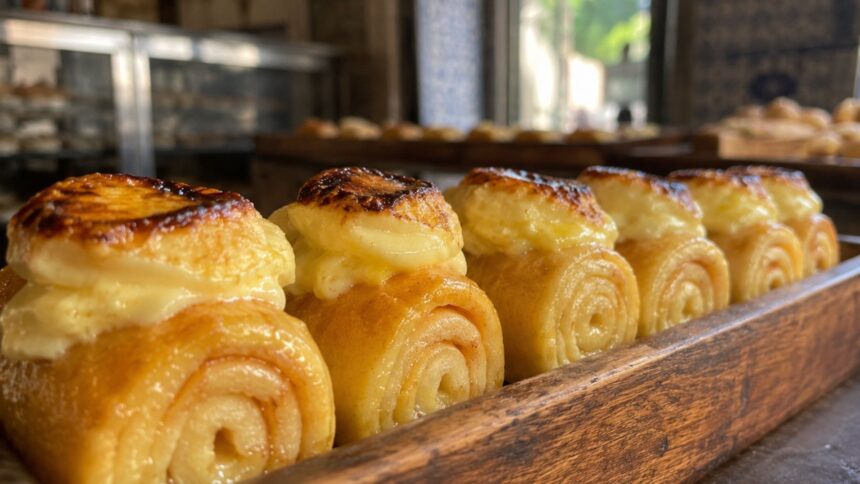
A pionono is small — usually just a few centimeters across — and built in layers:
- A very thin, tightly rolled sponge cake (bizcocho)
- Soaked in sugar syrup so it stays dense and moist rather than dry
- Filled with a cinnamon-spiced pastry custard
- Topped with a scorched or torched cream (crema tostada), giving a faint crème-brûlée crackle on top
It’s eaten in one or two bites, closer to a petit four than a slice of cake, which is part of why bakeries sell them by the box rather than the piece.
Where to Actually Try Them, If You’re in Granada
If your “near me” search should really read “near Granada,” these are the names that keep coming up across reviews and regional coverage:
- Pastelería Casa Ysla — Calle Real, Santa Fe, plus the A-92G roadside location and Granada-city branches. The original, and still the most-cited reference point for the “authentic” version.
- Café Pastelería López-Mezquita — Reyes Católicos 39, central Granada, open since 1862 (older than Casa Ysla itself, though known for a wider pastry menu). <cite index=”13-1″>Its pionono is regularly named among the best in Granada</cite>, alongside its churros con chocolate.
- Gran Café Bib-Rambla — a central-Granada café near Plaza Bib-Rambla frequently listed alongside the two above in local “where to eat pionono” roundups.
A Quick Snapshot
- Origin year: 1897
- Origin town: Santa Fe, Granada, Spain
- Named for: Pope Pius IX (“Pio Nono”)
- Core ingredients: Sponge cake, sugar syrup, cinnamon custard, toasted cream
- Typical price: Roughly €1–10 per person at Casa Ysla, per Google’s crowd-reported pricing
- Best paired with: Coffee — most Granada bakeries selling pionono are café-pastelería hybrids
People Also Ask
What is a pionono, exactly?
A pionono is a small rolled sponge cake from Santa Fe, Granada, soaked in syrup, filled with cinnamon custard, and topped with browned cream. It’s typically eaten in one or two bites and sold by the box in Andalusian bakeries.
Where do piononos originally come from?
Piononos originate from Santa Fe, a town near Granada in southern Spain. Pastry maker Ceferino Isla González is generally credited with creating the modern version at his bakery in 1897, though some historians trace earlier roots to Moorish-era Andalusian confectionery.
Can I buy authentic piononos outside Spain?
Rarely as fresh product. Because piononos rely on soft sponge and cream, they don’t travel or ship well, and no major bakery outside the Granada region is widely recognized for an authentic version. Some Spanish delis abroad sell shelf-stable or frozen approximations.
Why is it called “pionono”?
The name is a Spanish adaptation of “Pio Nono,” the Italian nickname for Pope Pius IX. Casa Ysla’s own account says founder Ceferino Isla wanted to honor the pope, and the pastry’s name later shifted to also honor Ceferino himself.
Is Casa Ysla the only place to get real piononos?
No. Casa Ysla is the founding bakery and most historically cited source, but other long-running Granada pastelerías, including López-Mezquita and Gran Café Bib-Rambla, are also well regarded for their versions.
The Bottom Line
There’s no shortcut here: if a search for piononos “near me” isn’t returning a result in or around Santa Fe and Granada, it isn’t returning the real pastry. Book the trip, or accept that you’re looking at a different dessert wearing a borrowed name.
Sources & Verification
- Turismo Santa Fe — official municipal tourism board, “Origen del Pionono”
- Encyclopaedia Britannica — biography of Pope Pius IX
- Pastelería Casa Ysla — official company history (pionono.com)
- Bake-Street.com — “Piononos from Santa Fé” (recipe and origin account)
- Siempredulces — regional food-history blog on Santa Fe piononos
- Granada Emprende — local business press on Casa Ysla’s expansion
- Café Pastelería López-Mezquita — visitor and review aggregator listings
Editorial note: Pricing, hours, and origin details above reflect publicly available bakery and review information at the time of writing and may change. Historical claims around the pastry’s exact origin are contested among local food historians and are presented here as such rather than as settled fact.