
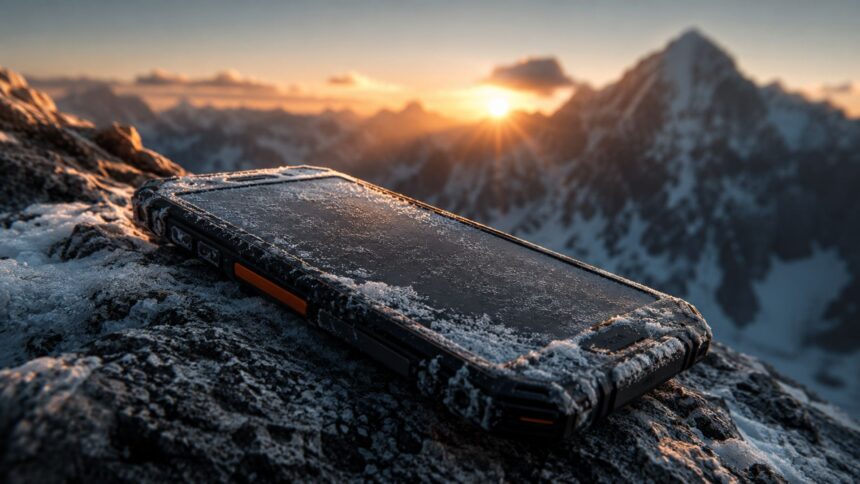
A dead phone at 12,000 feet isn’t an inconvenience — it’s the difference between a good story and a rescue call.
Every year, more hikers head into the backcountry carrying nothing but a regular smartphone as their map, radio, and emergency beacon rolled into one. And every year, some of those phones die on cue — a battery gutted by 15°F air, a cracked screen after one bad drop, a GPS signal that gives up in a narrow canyon exactly when it’s needed most. The gap between “phone that’s fine around town” and “phone that survives a mountain” is bigger than most people realize until they’re standing in it.
That gap is exactly what the rugged and outdoor-smartphone category exists to close. In 2026, that category has grown up fast: real satellite messaging, multi-day batteries, and navigation hardware that doesn’t fold in a tree-choked valley.
A mountain smartphone is a rugged, IP68/IP69K-rated device built for extreme outdoor use, typically featuring MIL-STD-810H drop and temperature certification, a 5,000mAh-or-larger battery, and multi-constellation GPS (GPS, GLONASS, Galileo, BeiDou). Some 2026 models add built-in satellite SOS messaging for true off-grid emergencies. That combination — not any single spec — is what separates a phone that merely “works outside” from one built to survive a mountain.
Why Your Regular Phone Struggles Above the Tree Line
Cold is the first thing that goes wrong. Lithium-ion batteries lose a meaningful chunk of their usable capacity as temperatures drop, and most flagship phones aren’t sealed or insulated against it the way dedicated outdoor hardware is. Add a cracked case from a rock-strewn scramble, a screen that won’t respond with wet or gloved fingers, and a GPS chip that was tuned for city blocks rather than switchback trails, and a phone built for the couch starts to look like the wrong tool for the job.
Reliable outdoor phones usually address this with multiple satellite positioning systems working simultaneously, which improves location accuracy in forests, mountains, and deep valleys where a single-network GPS chip can lose the plot. That’s a hardware difference, not a software tweak — it needs a chipset actually built to reference more satellites at once.
The Hardware Stack That Actually Matters
Not every “rugged” label means the same thing. Here’s what to actually check before trusting a phone above the tree line:
- Waterproofing (IP68/IP69K): IP68 covers submersion; IP69K adds resistance to high-pressure, high-temperature water jets — relevant for storms, not just puddles.
- Drop and shock rating (MIL-STD-810H): This is the U.S. military testing standard most rugged and outdoor phone manufacturers reference, covering drop resistance, vibration, humidity, temperature extremes, and altitude.
- Battery capacity: Outdoor-focused models increasingly run 10,000mAh and up, with some specialized models pushing past 20,000mAh.
- Multi-constellation GPS: GPS + GLONASS + Galileo + BeiDou (+ QZSS on some models) for a stronger fix in canyons and forest canopy.
- Satellite SOS/messaging: A small but growing number of rugged phones now build in two-way satellite texting, not just an SOS button.
- Glove- and wet-finger-friendly controls: Physical buttons and a display tuned to work with wet skin or gloves matter more on a mountain than they sound.
The 2026 Lineup: What’s Actually Shipping
The rugged phone market has genuinely matured this year — flagship processors and thermal cameras have made their way into bodies that can also survive a 2-meter drop onto rock.
| Phone | Standout Feature | Battery | Rugged Certs | Approx. Price |
|---|---|---|---|---|
| Ulefone Armor 29 Ultra | Dimensity 9300+ chip, dual AMOLED, 8K video | 21,200mAh | IP68/IP69K, MIL-STD-810H | Premium |
| CAT S75 | Built-in two-way satellite messaging (Bullitt) | 5,000mAh | IP68/IP69K, MIL-STD-810H | ~$599 |
| Samsung Galaxy XCover7 Pro | Full US carrier support, Knox security, hot-swap battery | 4,350mAh (removable) | IP68 | ~$557 |
| Doogee S200 | Infrared night-vision camera, underwater shooting mode | 10,000mAh-class | IP68/IP69K | Under $500 |
| Doogee V Max Pro | Battery-life focused, built for off-grid endurance | Very high capacity | IP68/IP69K | Mid-range |
The CAT S75 stands alone in this group with satellite messaging via Bullitt Satellite Connect, enabling off-grid two-way communication where no cell signal exists — a real differentiator for anyone heading past the last cell tower for days at a time. Meanwhile, the Samsung XCover7 Pro remains the enterprise standard thanks to genuine carrier support and Knox security, though it trades some of the extreme ruggedness of its Chinese competitors for that ecosystem reliability.
Do You Even Need a Dedicated Rugged Phone?
Here’s the honest complication: now that most mainstream phones are waterproof with long battery life, it’s arguable that a dedicated rugged outdoor phone is less important than it once was. A flagship iPhone or Galaxy in a good case will survive plenty of day hikes. The calculus changes once you’re talking multi-day treks, sub-freezing overnights, or routes with no cell coverage — that’s where the battery capacity and satellite comms of a purpose-built device start to earn their bulk and weight.
For genuinely serious backcountry travel — glacier crossings, first ascents, weeks off-grid — dedicated satellite phones and messengers still have a place, precisely for the deep expeditions where backups need backups. A rugged smartphone with satellite SOS is a strong middle ground, but it isn’t a full substitute for a dedicated device like a Garmin inReach on the most serious trips.
Quick Snapshot: What to Actually Prioritize
- Battery: 8,000mAh+ if you’re out for multiple days without a reliable charge
- Waterproofing: IP68 minimum, IP69K if you expect heavy rain or river crossings
- Navigation: Confirm multi-constellation GPS support, not just “GPS”
- Cold performance: Look for testing data down to at least -10°F/-20°C, and keep the phone insulated (inside a jacket, not an outer pocket) in freezing conditions
- Satellite messaging: Worth paying extra for if you regularly lose cell signal
- Grip and controls: Textured casing and physical buttons matter more than they look like they should once your hands are cold or wet
Frequently Asked Questions
What is a mountain smartphone?
A mountain smartphone is a rugged, weather-resistant device engineered to keep working in harsh outdoor conditions — typically IP68/IP69K waterproofing, MIL-STD-810H shock and temperature testing, a large battery, and strong GPS performance for hiking, trekking, and mountaineering.
Do rugged smartphones actually perform better in cold weather?
Not automatically. Battery chemistry still loses capacity in the cold regardless of the phone’s ruggedness. What rugged models add is sealing against condensation and a chassis rated for temperature swings — insulating the device (keeping it close to your body) still meaningfully improves real-world cold performance.
Can a mountain smartphone replace a satellite communicator like a Garmin inReach?
For casual and moderate trips, a rugged phone with built-in satellite SOS can cover basic emergency needs. For serious multi-day or remote expeditions, dedicated satellite communicators remain the more reliable backup because they’re purpose-built for message delivery over the Iridium network with less dependence on a fragile touchscreen.
How much battery capacity do I actually need for a multi-day hike?
It depends heavily on usage and temperature, but 8,000–10,000mAh is a reasonable floor for a few days of moderate use (photos, occasional GPS checks), with a power bank as backup. Heavy GPS tracking or cold weather will eat into that faster than the rated capacity suggests.
Is IP69K actually better than IP68 for hiking?
IP69K adds resistance to high-pressure, high-temperature water jets on top of IP68’s submersion rating. For most hikers, IP68 is enough; IP69K matters more if you expect sustained heavy rain, pressure-washing-equivalent exposure, or work-site conditions.
Are expensive rugged phones worth it over budget options?
Not always. Higher-end models add flagship processors, thermal cameras, or satellite messaging, but a budget rugged phone in the $300–500 range with solid IP68/IP69K and MIL-STD-810H certification will cover the core survival and durability needs of most hikers.
The Bottom Line for Anyone Heading Uphill
A mountain smartphone isn’t a status symbol — it’s closer to a piece of safety gear that happens to also take photos. The right pick depends entirely on how far off-grid you’re actually going: a well-cased flagship is plenty for a day hike, a rugged phone with a big battery and multi-constellation GPS covers most weekend trips, and satellite messaging (built-in or dedicated) becomes non-negotiable once you’re planning routes where help is genuinely hours or days away.
Sources Consulted
- TechRadar: CAT S75 Rugged Phone review
- Digital Camera World: Best rugged phone in 2026
- The Great Outdoors Magazine: Best smartphones for the outdoors 2026
- GearJunkie: The 5 Best Satellite Phones of 2026
- RugOne: Outdoor Phone Guide 2026
Editorial note: Pricing, specs, and product availability change frequently in the rugged-phone market. Figures above reflect information available as of mid-2026 and should be verified with the manufacturer before purchase.
By Techs Bullion Editorial Team